

An Overview of Windsor Castle: History, Layout & What to Expect
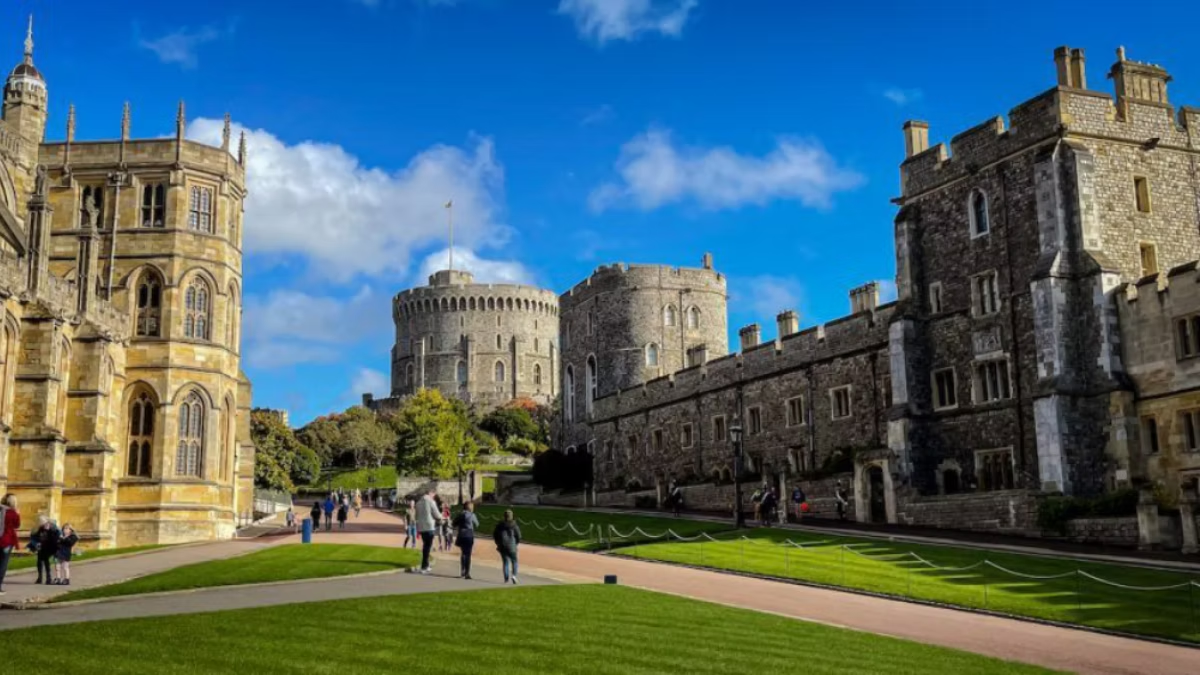
Windsor Castle is the oldest and largest occupied castle in the world, founded by William the Conqueror around 1070 and home to 40 monarchs across nearly 1,000 years. It covers 13 acres in the town of Windsor, 22 miles from London. Visitors can explore the State Apartments — lavishly furnished rooms still used for state occasions — St. George’s Chapel (burial place of 11 monarchs including Queen Elizabeth II), and Queen Mary’s Dolls’ House. The castle is open Thursday to Monday and costs approximately £32 in advance for adults.
Windsor Castle is not simply a famous building. It is the place where English and British royal history has most consistently happened — built as a fortress to dominate the Thames valley, converted over centuries into a palace, used as a refuge and a symbol of resilience during the Second World War, and still functioning today as the King’s regular weekend residence and the setting for state ceremonies. Visiting it requires only a morning or afternoon from London, but understanding it requires some context.
This overview covers what Windsor Castle is, the shape of its history, what the visitor experience includes, and what to prioritise on a first visit.
What Windsor Castle Is
Windsor Castle is a royal residence, a working palace, and a heritage site simultaneously — and the combination of all three is what gives it a character unlike almost any other place visitors can see in England.
A royal residence: Windsor Castle has been continuously occupied by the English and British royal family since Henry I began using it around 1110. King Charles III uses it as his regular weekend home. When the Royal Standard flies from the Round Tower, the King is in residence.
A working palace: The State Apartments are still used for state dinners, investitures, and diplomatic receptions. The rooms visitors walk through have been used in the past weeks for exactly the kind of ceremonial occasions for which they were built.
A heritage site: The castle’s thousand years of architectural evolution — from Norman earthworks to Tudor additions to George IV’s Gothic Revival transformation — create one of the most layered and historically rich structures in Europe. The Royal Collection displayed in the State Apartments contains works by Van Dyck, Rubens, Holbein, Rembrandt, and Canaletto. The 15th-century St. George’s Chapel is among the finest Gothic buildings in England.
Windsor Castle is the oldest and largest occupied castle in the world. Founded by William the Conqueror around 1070, it has been the home of 40 English and British monarchs. It serves simultaneously as a working royal residence used weekly by King Charles III, a ceremonial palace for state occasions, and one of England’s richest heritage sites. It is open to visitors Thursday to Monday, 22 miles from central London.
A Brief History
1066–1100: The Conqueror’s fortress William the Conqueror invaded England in 1066 and began building a series of defensive castles in a ring around London. Windsor was constructed around 1070 on a chalk cliff above the River Thames — strategically placed to control river traffic and to sit one day’s march from the Tower of London. The first structure was a motte-and-bailey: an earthen mound (still visible as the base of the Round Tower) with a wooden keep and a stockade.
1110–1300: From fortress to residence Henry I, William’s son, first used Windsor as a royal home around 1110 — beginning a continuous royal occupation that has lasted to the present day. Henry II replaced the wooden fortifications with stone in the 1170s, creating the stone Round Tower that still dominates the castle. Henry III added a royal chapel and grand apartments. Edward III — born at Windsor in 1312 — undertook the most ambitious reconstruction of the medieval period, creating what became the greatest secular building project in medieval England, and establishing the Order of the Garter at Windsor in 1348.
1350–1600: Tudor use and the chapel Edward IV began building the present St. George’s Chapel in 1475 — a project continued under Henry VII and completed under Henry VIII. Henry VIII died at Windsor in 1547 and was buried in the chapel beside Jane Seymour. Elizabeth I made significant use of Windsor for diplomatic entertainment, and it was reportedly during one of her visits that Shakespeare wrote The Merry Wives of Windsor.
1600–1800: Civil War, Restoration and renovation Windsor Castle served as a Parliamentary headquarters during the English Civil War and as a prison for Charles I — who was subsequently executed and buried at Windsor alongside Henry VIII. After the Restoration in 1660, Charles II undertook a complete rebuilding of the State Apartments, creating Baroque interiors with painted ceilings by Antonio Verrio and woodcarvings by Grinling Gibbons. George III began major renovations in the later 18th century.
1820–1900: George IV’s transformation George IV, working with architect Sir Jeffry Wyatville, undertook the most complete physical transformation of the castle in its history. The Round Tower was raised in height, the exterior of the Upper Ward was completely remodelled, St. George’s Hall was rebuilt, the Grand Reception Room was created, and the Semi-State Rooms were added. This is substantially the castle visitors see today. Queen Victoria made Windsor her principal palace and the centre of her court, spending increasing amounts of time there as her reign progressed.
20th century: Two world wars and Queen Elizabeth II During the Second World War, the young Princesses Elizabeth and Margaret sheltered at Windsor Castle while London was bombed. The castle itself was undamaged. In 1992 a severe fire destroyed or damaged over 100 rooms in the northeast corner of the castle — a five-year restoration completed in 1997 returned them to their former appearance. Queen Elizabeth II lived at Windsor as her primary residence from 2011 until her death there on 8 September 2022. She is buried in the King George VI Memorial Chapel within St. George’s Chapel.
What Visitors See
The State Apartments
The ceremonial heart of Windsor Castle and the principal indoor visitor attraction. Running along the north side of the Upper Ward, the State Apartments are the rooms used by the Royal Family for official state occasions today — and they look it. The visitor route moves through a sequence of increasingly grand spaces:
The Grand Entrance Hall and King’s Staircase — lined with arms and armour and providing the ceremonial approach to the principal rooms.
The Waterloo Chamber — a vast room created by George IV to commemorate the defeat of Napoleon. The walls are hung with portraits of the allied commanders and statesmen who contributed to the victory at Waterloo in 1815.
St. George’s Hall — the great banqueting room, 55 metres long, where State Dinners for up to 160 guests are held. The vaulted ceiling is painted with the arms of every Knight of the Garter since the Order was founded in 1348.
The Grand Reception Room — George IV’s principal ceremonial room, with gilded surfaces, crystal chandeliers, and a malachite urn presented to Queen Victoria by Tsar Nicholas I.
The historic rooms of Charles II — a sequence of smaller rooms — the Queen’s Drawing Room, the King’s Dining Room, the Queen’s Presence Chamber and others — that preserve the pattern of a 17th-century royal suite, furnished with paintings by Holbein, Van Dyck, and Rubens.
St. George’s Chapel
Built between 1475 and 1528, St. George’s Chapel is the spiritual home of the Order of the Garter — the oldest chivalric order in Britain — and one of the finest examples of Perpendicular Gothic architecture in England. The fan vaulting of the nave, the carved wooden stalls of the Knights and Ladies of the Garter, and the stained glass windows are exceptional. The chapel is the burial place of 11 monarchs: Edward IV, Henry VI, Henry VIII, Jane Seymour, Charles I, George III, George IV, William IV, George V, George VI, and Queen Elizabeth II.
St. George’s Chapel closes at 16:00 on weekdays and is closed to general visitors on Sundays.
Queen Mary’s Dolls’ House
Completed in 1924 to a design by architect Sir Edwin Lutyens, Queen Mary’s Dolls’ House is a 1:12-scale miniature palace built with contributions from over 1,500 craftspeople and artists. It features working electricity, running water, and a fully stocked wine cellar. The level of craftsmanship and detail is astonishing — the books in the miniature library are real, written by leading authors of the day; the paintings are original artworks created specifically for the house. Almost every visitor spends more time here than they expected.
The Castle Precincts
The outdoor areas of Windsor Castle — the Lower Ward, the Quadrangle, the North Terrace, the Moat Garden, and the Horseshoe Cloister — are included in admission and are fully photographable. The Round Tower, visible from miles around, dominates the Middle Ward. The North Terrace offers sweeping views across the Thames Valley.
The Semi-State Rooms (Autumn/Winter)
Five additional rooms — created by George IV as his private apartments — are added to the visitor route from approximately October to March at no extra charge. The Semi-State Rooms are currently being restored and are due to reopen in autumn 2026.
How to Make the Most of Your Visit
Book in advance. Windsor Castle uses timed-entry ticketing and can sell out, especially on weekends. Advance booking saves approximately £4 per adult and guarantees your entry time.
Go to St. George’s Chapel first. It closes at 16:00 on weekdays. If you visit the State Apartments first and then try to reach the chapel, you may find it closed.
Allow 2.5–3 hours minimum. The castle takes longer than visitors expect. Queen Mary’s Dolls’ House alone consumes 20–30 minutes for most people. A full visit including all accessible areas takes 3 hours comfortably.
Visit on a Thursday or Saturday to see the Changing of the Guard. The full Changing of the Guard ceremony takes place inside the castle precincts at 11:00 on Tuesdays, Thursdays, and Saturdays — visible with your admission ticket.
Avoid arriving at last admission if you want the chapel. The last admission in summer (16:00) leaves only 75 minutes before closing — not enough to see both the State Apartments and the chapel. Book a morning or early afternoon slot.
Frequently Asked Questions
What is Windsor Castle most famous for?
Its role as the oldest and largest occupied castle in the world, its more than 1,000-year continuous royal occupation, and more recently as the burial place of Queen Elizabeth II and the setting of the 2018 royal wedding of the Prince and Princess of Wales.
Is Windsor Castle better than Buckingham Palace?
For most visitors, yes — particularly outside summer when Buckingham Palace State Rooms are not open. Windsor offers greater historical depth, the Gothic chapel, and a fuller day out. For a detailed comparison, see our Windsor Castle vs Buckingham Palace guide.
How long has Windsor Castle been a royal residence?
Since approximately 1110, when Henry I began using it as a home — making it the longest continuously occupied royal palace in Europe.
Can you see the King at Windsor Castle?
Not typically. The King uses Windsor Castle as his weekend residence but the private apartments are closed to visitors. If the Royal Standard is flying from the Round Tower, the King is somewhere within the castle, but you will not encounter him on the visitor route.
