

Windsor Castle History: 1,000 Years of Royal Heritage
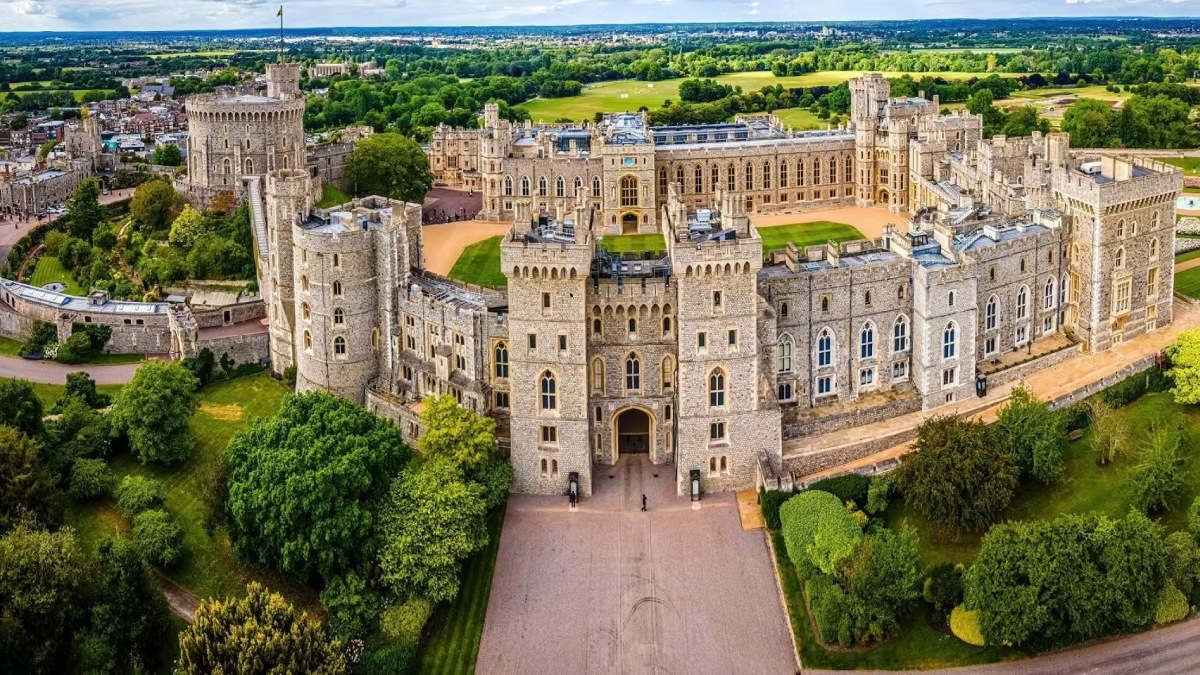
Windsor Castle was founded around 1070 by William the Conqueror as a defensive fortress guarding the western approaches to London. Henry I first used it as a royal residence from 1110. Over the following nine centuries, 40 successive monarchs shaped and expanded it into the building visitors see today — combining Norman fortifications, Tudor chapels, Stuart baroque interiors, and Georgian Gothic Revival architecture in one continuously occupied complex.
No other building in Britain tells the story of English and British monarchy as completely as Windsor Castle. Its walls layer nine centuries of royal ambition, military necessity, cultural aspiration, and personal attachment — from the earth mound William the Conqueror raised to dominate the Thames to the weekend home where Queen Elizabeth II chose to spend the last decade of her life.
The Norman Foundation: William the Conqueror (c. 1070)
Windsor Castle was built as an instrument of political control. After his conquest of England in 1066, William the Conqueror constructed a network of nine defensive castles in a ring around London, each placed approximately 25 miles apart — one day’s march from the city. Windsor was one of these strategic anchors.
Around 1070, William chose a chalk cliff above a bend in the River Thames — a commanding position overlooking a strategically vital stretch of water, close to the ancient royal hunting grounds of Windsor Forest. He built a motte-and-bailey castle: an artificial earthen mound (the motte) topped with a wooden keep, surrounded by a stockade enclosing a courtyard (the bailey). The castle’s purpose was defensive and symbolic — to project Norman power over the landscape and intimidate any remaining resistance.
The outer walls of Windsor Castle today stand in substantially the same position as those first Norman defences. The central mound on which the Round Tower sits is the same earthwork William raised. In this sense, the oldest element of the castle you can see is not a building at all — it is a hill.
The First Royal Residence: Henry I to Edward I (1110–1300)
Henry I, William’s youngest son and successor, was the first monarch to use Windsor Castle as a home rather than merely a fortress. He married Adela of Louvain at Windsor in 1121. From this point, Windsor’s character began to shift from purely military to a balance of defensive and residential.
Henry II undertook the first major transformation, replacing the wooden fortifications with stone between 1165 and 1179. He built the original stone Round Tower on the central mound, the outer walls of the Upper and Lower Wards, and royal apartments in the Upper Ward. The castle was now a permanent stone residence of considerable scale.
Henry III invested heavily in the royal accommodation during his long reign (1216–1272), constructing elaborate new apartments, a chapel in the Lower Ward (on the site now occupied by the Albert Memorial Chapel), and improving the castle’s overall comfort and appearance. His work helped establish Windsor as a preferred royal residence rather than simply a garrisoned fortress.
Edward I, the formidable military king, rebuilt and strengthened large sections of the castle from the 1270s onwards, adding new towers and further improving the fortifications in response to the baronial conflicts of the period.
The Castle Transformed: Edward III (1327–1377)
No medieval monarch did more to shape Windsor Castle than Edward III, who was born there in 1312. Between 1350 and 1377, Edward spent £51,000 on renovating Windsor — the largest single building investment by any English medieval monarch, equivalent to around one and a half times his typical annual income. This was described by later historians as “the most expensive secular building project of the entire Middle Ages in England.”
Edward’s motivation was partly dynastic ambition and partly idealism. Fascinated by the legend of King Arthur and the Knights of the Round Table, he reimagined Windsor Castle as a centre of chivalric culture. In 1348 he founded the Order of the Garter — the oldest and most senior order of chivalry in Britain, still active today — and made St. George’s Chapel its spiritual home. He built the immense St. George’s Hall, a banqueting room for the Garter Knights that eventually became the State Apartments’ central space.
Edward’s rebuilding transformed Windsor from a functional fortress into a genuine palace — the first English royal residence designed primarily to impress and to celebrate, rather than to defend.
The Tudor Chapel: Edward IV to Henry VIII (1475–1540s)
The present St. George’s Chapel was begun by Edward IV in 1475, as he sought a mausoleum worthy of the Yorkist dynasty. Work continued under Henry VII and was finally completed under Henry VIII, who added the magnificent fan vaulting over the crossing in 1528. The chapel represents the highest achievement of the Perpendicular Gothic architectural style — the distinctively English form characterised by vertical lines, large windows, and soaring fan vaults.
Henry VIII died at Windsor in 1547 and was buried in the chapel alongside his third wife, Jane Seymour. He had specifically requested burial at Windsor rather than Westminster. Elizabeth I later used Windsor extensively for diplomatic entertainment — it was reportedly during a royal visit to Windsor that Shakespeare wrote The Merry Wives of Windsor.
Civil War, Interregnum, and Restoration (1642–1700)
The English Civil War (1642–1651) brought Windsor Castle under Parliamentary control. In October 1642, Parliamentary forces seized the castle. It served as a military headquarters and a prison for captured Royalist officers throughout the conflict. Charles I, the only English monarch to be tried and executed by his own parliament, was held at Windsor before his execution in London in January 1649. His body was returned to Windsor by night through a snowstorm and buried without ceremony in St. George’s Chapel alongside Henry VIII.
Oliver Cromwell subsequently used Windsor as one of his official residences during the Interregnum.
At the Restoration of the monarchy in 1660, Charles II reclaimed Windsor and set about making it magnificent. Determined to rival his cousin Louis XIV of France at Versailles, he undertook a complete rebuilding of the State Apartments between 1675 and 1682, working with architect Hugh May. The results were among the grandest interiors in England: Baroque painted ceilings by Antonio Verrio depicting mythological and historical scenes, and extraordinary woodcarvings by Grinling Gibbons — some of the finest examples of their craft in existence. Many of these interiors survive today, though partly modified by later monarchs.
Neglect and Revival: The Hanoverian Century (1714–1820)
The first Hanoverian monarchs — George I and George II — showed little interest in Windsor, preferring Hampton Court and Kensington Palace. For much of the early 18th century the castle was underused and its apartments fell into a degree of neglect. Prominent widows and friends of the Crown were given its rooms as “grace and favour” privileges.
George III changed this decisively. From 1760 he worked to revive Windsor as a centre of royal life, beginning a series of renovations and improvements that eventually gave the Upper Ward its Gothic character. He also enriched the Royal Collection at Windsor significantly, acquiring over 200 Old Master paintings. His son, the Prince Regent (later George IV), continued and amplified this work in the most transformative single building campaign since Edward III.
George IV’s Transformation (1824–1830)
George IV’s architectural ambitions at Windsor were boundless. Working with architect Sir Jeffry Wyatville from 1824, he spent the modern equivalent of hundreds of millions of pounds on a complete remodelling of the castle’s exterior and interior. The results define Windsor Castle as visitors experience it today:
- The Round Tower was raised by approximately 30 feet to create a more dramatic, medievalising silhouette
- The exterior of the Upper Ward was completely remodelled, with new towers, battlements, and crenellations
- St. George’s Hall was rebuilt (enlarged to its current 55-metre length) and fitted with its spectacular heraldic ceiling
- The Grand Reception Room, Garter Throne Room, and other principal State Apartments were created or remodelled in a mix of Rococo, Gothic, and Baroque styles
- The Semi-State Rooms — George IV’s private apartments — were created in the south range
- The Long Walk was replanted and extended to create the finest formal approach to any royal palace in Britain
Wyatville’s work gave Windsor its current appearance: romantic, medievalising, and deliberately theatrical. As architect Sir William Whitfield later noted, the design has “a certain fictive quality” — a theatrical performance of medievalism built onto genuinely medieval structures.
Queen Victoria and the Victorian Era (1837–1901)
Queen Victoria and Prince Albert were deeply devoted to Windsor Castle. Victoria’s reign saw it become the centre of the British Empire’s court life — a hub of diplomatic visits, state occasions, and royal family gatherings. Foreign ambassadors, ministers, and heads of state came from across the world.
In 1845, under Victoria’s reign, the State Apartments were first opened to the public — a landmark moment in the development of Windsor as a visitor attraction. Prince Albert died of typhoid at Windsor in 1861 and was buried at Frogmore, a mausoleum Victoria constructed in the Home Park. Victoria herself spent increasing amounts of time at Windsor as she aged and was buried alongside Albert at Frogmore in 1901.
The 20th Century: Two World Wars and Modern Royalty
During the First World War, the castle’s association with a German-named dynasty became politically sensitive. In 1917, facing anti-German public sentiment, King George V changed the Royal Family’s name from Saxe-Coburg-Gotha to Windsor — after the castle itself. The castle gave its name to the dynasty, rather than the other way around.
During the Second World War, the young Princesses Elizabeth and Margaret were sheltered at Windsor as London faced the Blitz. The castle itself was protected — apparently never directly targeted, though the reasons for this remain a matter of historical discussion.
The 1992 Fire
On 20 November 1992 — the 45th wedding anniversary of Queen Elizabeth II and Prince Philip — fire broke out in the Private Chapel of Windsor Castle during renovation works. It spread with devastating speed through the northeast corner of the Upper Ward, destroying or severely damaging over 100 rooms including St. George’s Hall. It took 250 firefighters and approximately 1.5 million gallons of water nearly 15 hours to extinguish.
Most movable artworks and furniture had been removed for the renovation, limiting losses to the collection. The five-year restoration, completed in 1997, was funded largely by opening Buckingham Palace to summer visitors. The restored rooms — particularly St. George’s Hall and the Grand Reception Room — were rebuilt to their original designs using authentic materials and traditional craftsmanship, and are considered a remarkable example of modern heritage restoration.
Queen Elizabeth II and the Present Day
Queen Elizabeth II maintained Windsor Castle as her primary weekend residence throughout her reign, spending Easter there each year and using it for official state occasions including state visits from foreign heads of state. From 2011 onwards she lived at Windsor predominantly, and it became her primary residence.
She died at Windsor Castle on 8 September 2022. Her state funeral at Westminster Abbey was followed by a committal service in St. George’s Chapel, where she was buried in the King George VI Memorial Chapel alongside her husband Prince Philip, her father George VI, her mother Queen Elizabeth The Queen Mother, and her sister Princess Margaret.
King Charles III continues the tradition — Windsor is his regular weekend residence, and the castle remains one of the two principal working royal residences in England.
Windsor Castle in History: Key Dates
| Year | Event |
|---|---|
| c. 1070 | William the Conqueror builds the first motte-and-bailey castle |
| c. 1110 | Henry I first uses Windsor as a royal residence |
| 1170s | Henry II rebuilds in stone: Round Tower and outer walls |
| 1348 | Edward III founds the Order of the Garter at Windsor |
| 1350–77 | Edward III undertakes the greatest medieval building programme |
| 1475–1528 | St. George's Chapel built (Edward IV to Henry VIII) |
| 1547 | Henry VIII buried at Windsor |
| 1649 | Charles I executed; buried at Windsor |
| 1675–82 | Charles II rebuilds State Apartments in Baroque style |
| 1824–30 | George IV and Wyatville remodel the castle's exterior and interiors |
| 1845 | State Apartments first opened to the public (Queen Victoria) |
| 1917 | Royal Family adopts the name Windsor |
| 1940–45 | Princesses Elizabeth and Margaret shelter at Windsor during WWII |
| 1992 | Fire destroys over 100 rooms; restoration completed 1997 |
| 2018 | Wedding of the Prince and Princess of Wales in St. George's Chapel |
| 2022 | Queen Elizabeth II dies at Windsor; buried in St. George's Chapel |
Frequently Asked Questions
Who built Windsor Castle?
William the Conqueror began the original castle around 1070. However, the castle as visitors see it today is largely the product of George IV’s 1820s remodelling, overlaid on medieval, Tudor, and Stuart foundations.
How long has Windsor Castle been a royal residence?
Since approximately 1110, when Henry I first used it as a home. This makes it the longest continuously occupied royal palace in Europe.
Why is Windsor called Windsor?
The name derives from a Norman word meaning “riverbank with a winch” — a reference to the site’s position above the Thames. When King George V changed the royal family name in 1917, he chose Windsor from the castle rather than the other way around.
What happened in the 1992 fire?
Fire broke out during renovation works on 20 November 1992, destroying or damaging over 100 rooms. The five-year restoration was completed in 1997 and is widely regarded as an exemplary heritage restoration project.
