

The State Apartments at Windsor Castle: What to See Inside
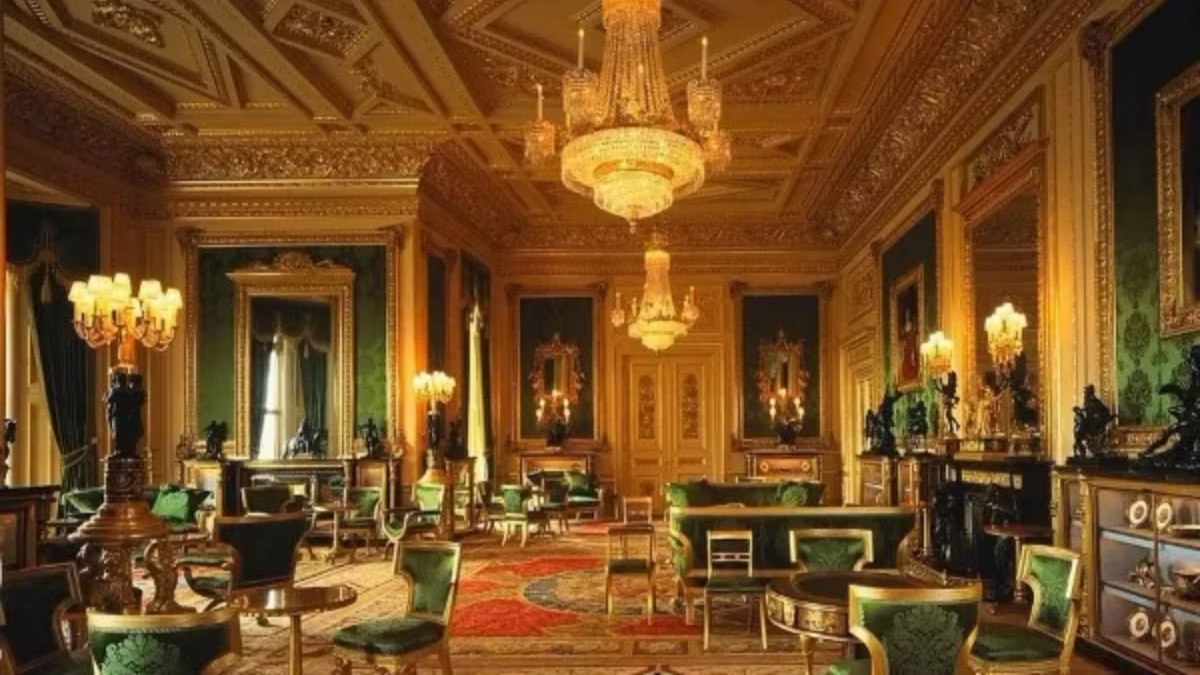
The State Apartments are the ceremonial heart of Windsor Castle and the principal indoor visitor experience. Running along the north side of the Upper Ward, they contain rooms still used by the King for state occasions, furnished with one of the world’s finest collections of Old Master paintings. The route is one-way and takes 60–90 minutes at a comfortable pace. Photography is not permitted. The Semi-State Rooms — George IV’s private apartments — are added to the route in autumn and winter at no extra charge and are due to reopen in autumn 2026.
The State Apartments at Windsor Castle are not a museum display. They are working rooms — still laid with silver, still hung with portraits collected by the kings and queens who lived here, still used for the investitures and state dinners that form part of the business of modern monarchy. Walking through them carries a quality that no amount of description fully prepares you for: the accumulated weight of nine centuries of royal occupation, expressed in room after room of extraordinary objects.
What the State Apartments Are
The State Apartments are two distinct but connected sequences of rooms within the Upper Ward of Windsor Castle:
The Ceremonial Rooms — the principal State Apartments used today for official royal functions: state visits from foreign heads of state, investitures (where the King confers honours and decorations), and major ceremonial occasions. These rooms were largely created or remodelled by George IV in the 1820s, incorporating elements from earlier Stuart and Baroque interiors.
The Historic Rooms of Charles II — a sequence of older rooms built in the 17th century for Charles II and his queen, Catherine of Braganza. These follow the traditional English palace layout of rooms becoming progressively more private as you move further in — from the public-facing Guard Chamber through the Presence Chamber and Audience Chamber to the most intimate spaces.
Both sequences are included in every standard Windsor Castle admission ticket.
The State Apartments are the ceremonial and historic rooms in the Upper Ward of Windsor Castle open to visitors. They include rooms still used by the King for state occasions — invested with paintings by Van Dyck, Rubens, and Holbein — and older rooms built for Charles II in the 17th century. The visit is self-guided (with the included audio guide) and typically takes 60–90 minutes. Photography is not permitted inside.
The Principal Rooms
The Grand Entrance Hall and King’s Staircase
The visitor approach to the State Apartments begins with the Grand Entrance Hall, added by George IV as part of his 1820s remodelling. The adjacent King’s Staircase is lined with arms and armour arranged in geometric patterns — helmets, pistols, swords, and shields covering every surface. It is a deliberately intimidating ceremonial introduction, designed to project royal power before the state rooms are even reached.
The Grand Vestibule
The first major room of the ceremonial sequence, the Grand Vestibule was also designed by Wyatville for George IV. It contains a remarkable trophy of war: the bullet that killed Lord Nelson at Trafalgar, displayed in a glass case alongside other military mementoes. The ceiling is richly decorated and the walls hung with arms captured in battle.
The Waterloo Chamber
One of the most dramatic rooms in the castle, the Waterloo Chamber was created by George IV to commemorate the defeat of Napoleon at the Battle of Waterloo in 1815. The room is approximately 32 metres long, and its walls are lined from floor to ceiling with portraits commissioned from Sir Thomas Lawrence — 28 in total — depicting the kings, generals, statesmen, and diplomats who contributed to the Napoleonic Wars and their aftermath. The subjects include George III, the Duke of Wellington, Field Marshal von Blücher, Tsar Alexander I of Russia, Emperor Francis I of Austria, King Frederick William III of Prussia, and Pope Pius VII. The table in this room is still laid for State Banquets.
St. George’s Hall
The great banqueting room of Windsor Castle, St. George’s Hall is 55 metres long — the longest room in the castle — and the principal venue for State Dinners, which seat up to 160 guests. The vaulted ceiling is painted with the heraldic shields of every Knight of the Garter since the Order’s foundation in 1348. This room was among the most severely damaged in the 1992 fire and was completely rebuilt. The restoration, completed in 1997, is considered one of the finest achievements of modern heritage craftsmanship in Britain.
The Grand Reception Room
The most visually dramatic of the ceremonial rooms. The Grand Reception Room was used as the castle’s main ballroom and is decorated with gilded plaster ceilings (recreated after the 1992 fire), crystal chandeliers, and walls covered in French Rococo-inspired decoration. The centrepiece is a colossal malachite urn — approximately 1.5 metres tall — presented to Queen Victoria by Tsar Nicholas I of Russia in 1839. It is one of the largest malachite objects outside Russia.
The Garter Throne Room
The room where the King receives newly appointed Knights and Ladies of the Order of the Garter. The Throne — surmounted by a canopy — stands at the far end, and the room is decorated with the heraldic devices of the Order. The ceiling is particularly ornate.
The Presence Chamber, Audience Chamber, and King’s Drawing Room
These rooms form part of the historic sequence built for Charles II in the 1670s, following the pattern of a 17th-century English royal palace: a series of progressively more private rooms through which courtiers had to be admitted in stages to approach the monarch. The painted ceilings originally installed by Antonio Verrio — among the most celebrated decorative painters of the Baroque period — were partially covered by later remodelling but traces of his original scheme survive. Grinling Gibbons’ woodcarvings, considered the finest work of their kind in existence, survive in several of these rooms: cascades of limewood fruit, flowers, birds, and foliage carved with extraordinary delicacy.
The King’s State Bedchamber
A magnificent bed, originally acquired by George IV, dominates this room — one of the most opulent royal bedchambers open to the public in England. The room also contains fine examples of French furniture and Sèvres porcelain from the Royal Collection.
The Drawings Gallery
A long gallery displaying rotating selections of works on paper from the Royal Collection — one of the greatest collections of drawings in the world, including original works by Leonardo da Vinci, Michelangelo, Raphael, Raphael’s students, Hans Holbein the Younger, and other Old Masters. The displayed selection changes regularly.
The Art Collection
The paintings displayed throughout the State Apartments represent one of the finest accessible collections of European art anywhere. Many works hang in the rooms for which they were originally collected or commissioned — giving them a context and presence unavailable in any museum setting.
Key artists represented:
- Sir Anthony van Dyck — court painter to Charles I, whose portraits of the 17th-century English court dominate several rooms
- Peter Paul Rubens — several large-scale works including mythological and historical subjects
- Hans Holbein the Younger — portrait drawings and paintings from the Tudor court
- Rembrandt van Rijn — works from the Royal Collection
- Canaletto — views of Venice and of Windsor itself, commissioned by George III
- Sir Thomas Lawrence — the Waterloo portraits and other 19th-century works
The Semi-State Rooms
The Semi-State Rooms are five additional apartments created by George IV as his private rooms — distinct from the more formal State Apartments and representing a more personal vision of royal luxury. They are decorated in a blend of Gothic, Classical, and Rococo styles incorporating furnishings and fittings brought from Carlton House, George IV’s former London residence.
The five rooms are the Crimson Drawing Room, the Green Drawing Room, the White Drawing Room, the Octagon Dining Room, and the Augusta Tower. They contain some of the finest English and French decorative arts of the early 19th century.
Important 2026 note: The Semi-State Rooms are currently closed for restoration and are due to reopen in autumn 2026. When open, they are added to the visitor route from approximately October to March at no extra charge. Check rct.uk for the confirmed reopening date before your visit.
The 1992 Fire and Restoration
On 20 November 1992, fire broke out in the Private Chapel during renovation work and rapidly spread to the northeast corner of the Upper Ward. St. George’s Hall, the Grand Reception Room, and the Crimson Drawing Room were among the spaces most severely damaged. Over 100 rooms were destroyed or damaged.
The restoration, completed in 1997, is widely regarded as an exemplary heritage project. St. George’s Hall was rebuilt with a new oak ceiling incorporating 76 heraldic shields; the Grand Reception Room’s gilded ceiling was recreated in limewood using traditional methods; the Crimson Drawing Room was fully restored using original designs. The project used traditional craftspeople — carpenters, plasterers, gilders, upholsterers — working from historical records and surviving fragments, and the results are considered indistinguishable from the original in most respects.
Practical Information
Entry: Included with standard Windsor Castle admission ticket. No separate ticket required.
Photography: Not permitted inside the State Apartments or Semi-State Rooms.
Time to allow: 60–90 minutes for the main route at a comfortable pace. Longer if you engage with the audio guide in detail.
Audio guide: The free multimedia guide is strongly recommended — many rooms have minimal labelling, and the guide provides context for the paintings, furniture, and decorative schemes that is not otherwise available.
Bags: Large bags and pushchairs must be checked in at the cloakroom near the China Museum before entering the State Apartments. Allow 10 minutes for the uphill walk to the cloakroom.
Route: One-way only. You cannot return to earlier rooms once you have passed through.
Frequently Asked Questions
Do you need a separate ticket for the State Apartments?
No. The State Apartments are included with every standard Windsor Castle admission ticket at no extra charge.
Can you take photographs inside the State Apartments?
No. Photography and filming are not permitted inside the State Apartments, Semi-State Rooms, or St. George’s Chapel.
When are the Semi-State Rooms open?
Normally from approximately October to March at no extra charge. They are currently closed for restoration and due to reopen in autumn 2026. Check rct.uk for the confirmed date.
How long does it take to go through the State Apartments?
Allow 60–90 minutes at a comfortable pace. The full visit including the chapel, Dolls’ House, and precincts typically takes 2.5–3 hours.
What are the best things to look for in the State Apartments?
The Waterloo Chamber portraits by Lawrence, Grinling Gibbons’ woodcarvings in the historic rooms, the malachite urn in the Grand Reception Room, Van Dyck portraits throughout, and the vaulted ceiling of St. George’s Hall.
