

The Royal Collection at Windsor Castle: Art, Armour & Treasures
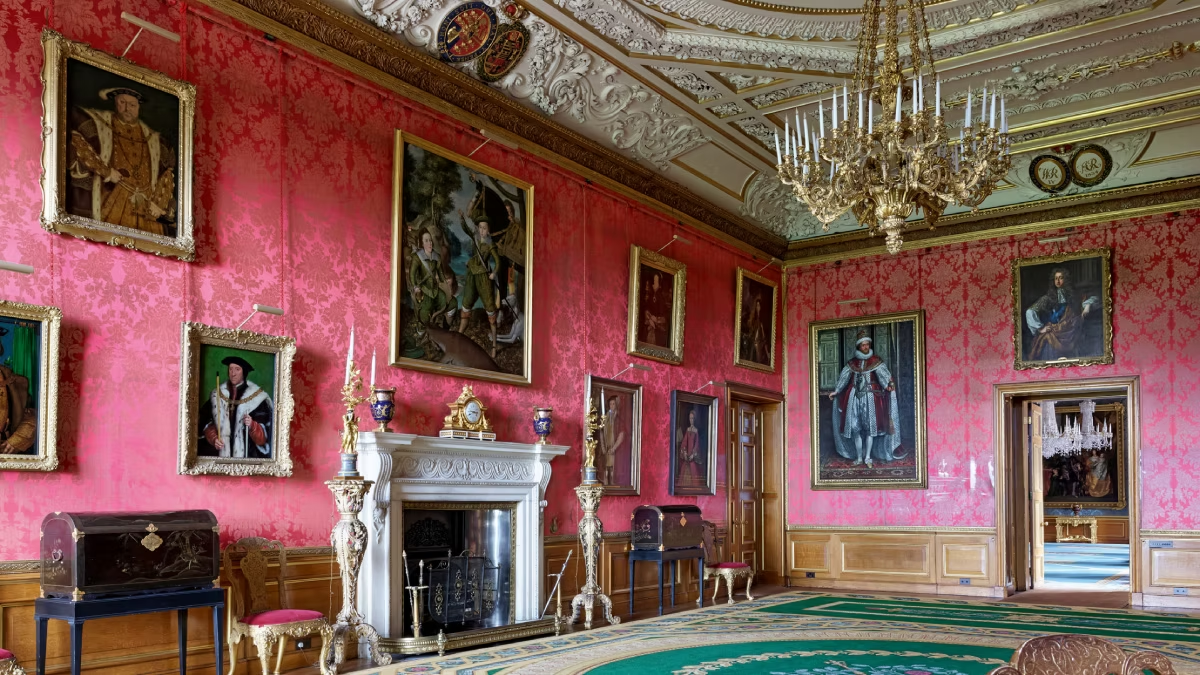
Windsor Castle holds one of the most significant portions of the Royal Collection — one of the largest and most important art collections in the world, encompassing over one million objects. Works on display in the State Apartments include paintings by Van Dyck, Rubens, Holbein, Rembrandt, and Canaletto, alongside extraordinary displays of armour (including Henry VIII’s jousting armour), French furniture, porcelain, sculpture, and the Drawings Gallery containing original works by Leonardo da Vinci, Michelangelo, and Raphael. Everything is included in the standard admission ticket.
The Royal Collection is not a museum collection in the conventional sense. It has never been formally acquired as a curated whole, has no founding moment, and was not designed for public exhibition. It is the accumulated result of nearly a thousand years of royal patronage, gifting, inheritance, and purchase — and at Windsor Castle, much of it is displayed in the rooms for which it was originally collected, often by the very monarchs whose portraits hang on the walls beside it.
Visiting the Royal Collection at Windsor is different from visiting any national museum. The context is the rooms themselves. A Van Dyck portrait of Charles I hangs in the rooms built by Charles I’s son. Canaletto views of Venice hang in rooms designed by the monarch who commissioned them. This layering of context and object is what gives the collection at Windsor a character impossible to replicate in any purpose-built gallery.
Scale and Scope of the Collection at Windsor
The Royal Collection as a whole comprises over one million objects across all royal residences, including approximately 7,000 paintings, more than 150,000 works on paper (including 30,000 watercolours and drawings), around 700,000 works of decorative art, and approximately 450,000 photographs. Windsor Castle holds a substantial and disproportionately important share of these objects — particularly in paintings, drawings, arms and armour, and French decorative arts.
The collection is held in trust by the monarch for the nation and overseen by the Royal Collection Trust, a registered charity. All entry fees to Windsor Castle contribute to the collection’s maintenance and conservation.
Windsor Castle contains one of the finest accessible displays of Old Master paintings in Europe, including works by Van Dyck, Rubens, Rembrandt, Holbein, and Canaletto. The Drawings Gallery holds rotating selections from the world’s greatest private drawing collection — including originals by Leonardo da Vinci, Michelangelo, and Raphael. The Grand Entrance displays arms and armour including Henry VIII’s jousting armour. All are included with standard admission.
Paintings: The Old Masters
The paintings displayed throughout the State Apartments represent one of the most significant concentrations of Old Master works accessible to the public anywhere in Britain. Key artists and works include:
Sir Anthony van Dyck (1599–1641) Van Dyck was court painter to Charles I, and his portraits of the Stuart court constitute the single most important group of paintings in the collection. The large equestrian portrait of Charles I with his riding master M. de St. Antoine (in the Queen’s Ballroom) is one of the most celebrated royal portraits in existence — a political statement as much as a likeness, depicting the king as ruler, warrior, and knight. Multiple Van Dyck portraits hang throughout the historic rooms of Charles II.
Peter Paul Rubens (1577–1640) Rubens contributed several major works to the collection, including mythological and religious subjects displayed in the State Apartments. His portraiture and grand history paintings represent the apotheosis of Flemish Baroque painting.
Hans Holbein the Younger (c. 1497–1543) Holbein was court painter to Henry VIII and his portraits of the Tudor court at Windsor — both paintings and portrait drawings — are among the most significant records of 16th-century English royal life. His drawings (in the Drawings Gallery) include many of the most celebrated portrait drawings in existence.
Rembrandt van Rijn (1606–1669) Works by Rembrandt from the Royal Collection are among the finest examples of his painting accessible anywhere in England.
Canaletto (Giovanni Antonio Canal, 1697–1768) George III commissioned Canaletto to paint a series of views of Windsor Castle and Windsor Great Park, and the collection also includes his celebrated Venetian vedute. The Canaletto rooms display works in the settings for which they were acquired.
Sir Thomas Lawrence (1769–1830) The Waterloo Chamber contains Lawrence’s series of 28 portraits commissioned to commemorate the defeat of Napoleon — kings, generals, emperors, and statesmen, painted between 1814 and 1820. It is the greatest concentrated display of Lawrence’s portraiture in existence.
Other significant artists: The collection also includes works by Holbein, Bruegel the Elder, Jan Steen, Frans Hals, Gerrit Dou, and many other Northern European masters, as well as a strong representation of British portraiture from Lely and Kneller through Reynolds and Gainsborough.
The Drawings Gallery
The Drawings Gallery is one of the most remarkable spaces accessible to visitors at Windsor Castle, and one of the most underappreciated. Housed in a long gallery within the Upper Ward, it displays rotating selections from the Royal Collection’s holdings of works on paper — a collection without parallel in private hands.
Leonardo da Vinci (1452–1519): The Royal Collection holds approximately 600 drawings by Leonardo — the largest single collection of his work anywhere in the world. The selections on display at Windsor rotate regularly and may include anatomical studies, figure drawings, landscape sketches, and engineering designs. The quality and breadth of the Windsor Leonardo collection is extraordinary even to specialists.
Michelangelo (1475–1564): Original drawings by Michelangelo, including figure studies and architectural sketches, are held in the collection and rotate through the gallery.
Raphael (1483–1520): Studies and compositional drawings by Raphael from the collection are among the most important Renaissance works on paper accessible to the public anywhere.
Hans Holbein the Younger: The portrait drawings by Holbein in the collection — made from life in the Tudor court — include many of the finest surviving Renaissance portrait drawings in existence. Their directness and psychological acuity remain compelling five centuries after they were drawn.
Note: The displayed selection in the Drawings Gallery changes with each exhibition. The current display is described at rct.uk before your visit.
Arms and Armour
The arms and armour displayed at Windsor Castle — particularly in the Grand Vestibule and Grand Entrance on the King’s Staircase — constitute one of the most important historic collections in England.
Henry VIII’s Jousting Armour (Lantern Lobby) The armour made for Henry VIII and displayed in the Lantern Lobby is one of the most extraordinary objects in the castle. Made in the 1540s, it was specifically designed for jousting and includes an unusual feature: it was made adjustable at the waist, allowing it to be modified as the king’s legendary appetite increased his girth in his later years. Examining this detail — the technical solution to an entirely human problem — is one of those small moments of historical intimacy the castle specialises in.
The Grand Vestibule The first major room of the ceremonial State Apartments contains military trophies, including the bullet recovered from the body of Lord Nelson at the Battle of Trafalgar in 1805 — displayed in a glass case alongside other Napoleonic-era mementoes.
The King’s Staircase The approach to the State Apartments is lined on all sides with arms arranged in geometric patterns — pistols, helmets, swords, and shields, covering every surface in a deliberately intimidating display of royal military power.
French Furniture and Decorative Arts
Windsor Castle holds one of the greatest collections of French 18th-century furniture anywhere in the world — assembled largely by George IV, who had a profound appreciation for French Ancien Régime craftsmanship. The Semi-State Rooms in particular (due to reopen in autumn 2026) contain the finest expression of this collection, with pieces by the greatest French cabinet-makers including André-Charles Boulle and Pierre-Antoine Bellangé.
The State Apartments also contain exceptional examples of Sèvres porcelain, including large pieces presented as diplomatic gifts between the French royal family and the British monarchy.
Sculpture and Objects
Throughout the State Apartments, the collection includes exceptional examples of European sculpture and decorative objects. The most immediately striking single object is the malachite urn in the Grand Reception Room — approximately 1.5 metres tall, presented to Queen Victoria by Tsar Nicholas I of Russia in 1839 and one of the largest malachite objects outside Russia.
Other notable objects include Meissen and Sèvres porcelain services, silver-gilt plate displayed in several rooms, bronzes, and an extraordinary range of clocks and scientific instruments.
Practical Information
The Royal Collection at Windsor is accessed entirely as part of the standard visitor route through the State Apartments — there are no additional charges or separate exhibition tickets for anything on display.
Photography is not permitted inside the State Apartments. A searchable database of the collection, including objects on display at Windsor, is available at rct.uk/collection.
Audio guide: The free multimedia audio guide provides commentary on many of the key works in the State Apartments and is essential for getting the most from the collection without specialised knowledge.
Frequently Asked Questions
Is the art in the Windsor Castle State Apartments the original or reproductions?
The works displayed are originals. The Royal Collection does not use reproductions for display purposes. All paintings, drawings, furniture, and objects on the visitor route are the actual works from the collection.
Can I research specific objects before my visit?
Yes. The Royal Collection Trust maintains a searchable online database at rct.uk/collection with images and descriptions of most objects in the collection, including notes on where individual works are displayed.
Is the collection ever lent to other museums?
Yes. Approximately 3,000 objects from the Royal Collection are on long-term loan to museums worldwide. Some works rotate between royal residences or between exhibitions. The display at Windsor is broadly stable but individual works may move.
What are the most important things to see in the Royal Collection at Windsor?
The Van Dyck portrait of Charles I, the Waterloo Chamber Lawrence portraits, the Holbein portrait drawings in the Drawings Gallery, Henry VIII’s jousting armour, the malachite urn, and any Leonardo drawings currently on display in the Drawings Gallery.
