

Windsor Castle's Dungeon & Curfew Tower: History & What to See
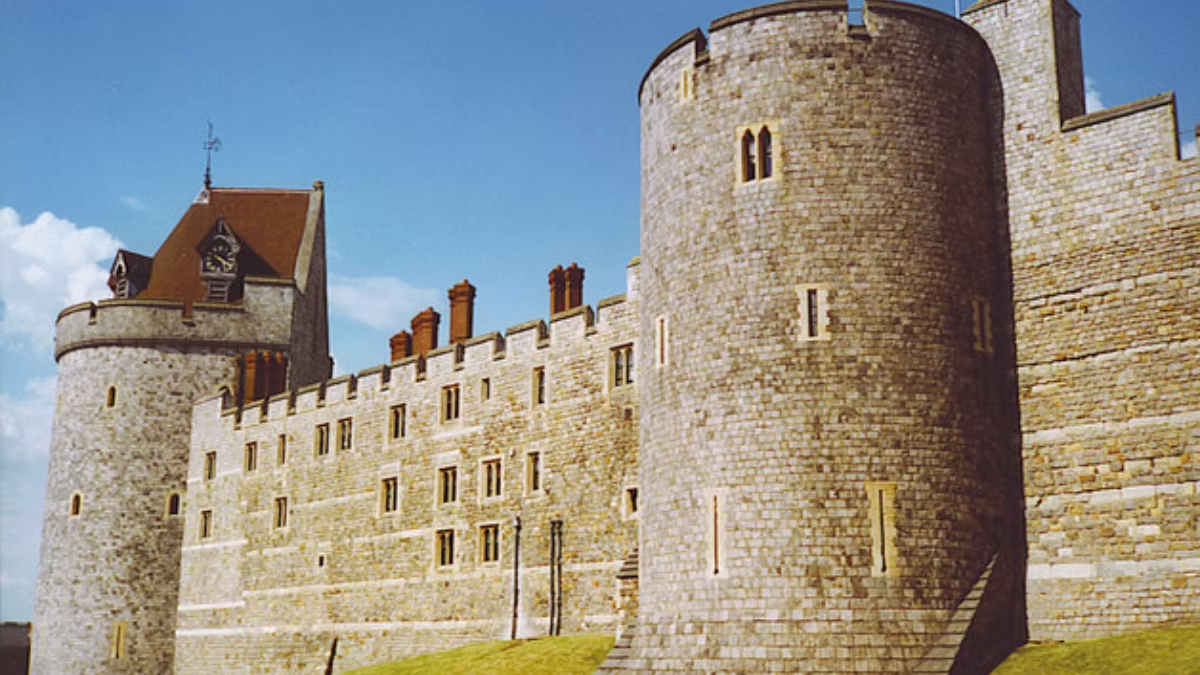
The Curfew Tower is a 13th-century defensive tower in the Lower Ward of Windsor Castle, built between 1227 and 1230. Its walls are 13 feet thick and it stands 100 feet high. The tower contains a historic dungeon — a vaulted chamber where prisoners were held from the medieval period through the English Civil War — and houses the bells of St. George’s Chapel and the castle clock. The tower exterior is visible to all visitors. The interior is not open to general visitors as part of the standard route.
Windsor Castle does not have a dedicated dungeon attraction in the theatrical sense. What it does have is something more historically genuine: the Curfew Tower, one of the oldest surviving structures in the entire castle, whose basement has been used as a prison for prisoners ranging from medieval debtors to Civil War captives, and whose walls contain the evidence of escape attempts, prisoner graffiti, and centuries of incarceration. The tower’s story is less dramatic than any staged dungeon experience — and considerably more interesting.
The Curfew Tower: Origins and Construction
The Curfew Tower was built between 1227 and 1230, under the direction of William de Milleriis, as part of a major programme of defensive strengthening ordered by Henry III following the siege of Windsor during the reign of King John in 1216. Three towers were built along the western castle wall at a total cost of £432 14s 4d — the Curfew (then called the Clewer Tower), the Garter Tower, and the Salisbury Tower. Their construction marked the completion of the entire replacement of Windsor’s original wooden western defences with stone.
The tower’s foundations extend into the original Norman ditch — the defensive earthwork created by William the Conqueror around 1070. Its walls at the base are 13 feet (approximately 4 metres) thick, rising to a height of 100 feet (approximately 30 metres). It stands at the northwest corner of the Lower Ward, the most vulnerable angle of the western defences. The D-shaped plan of the tower — circular on the outer face, flat on the inner — is a characteristic design of early 13th-century castle engineering.
Yes, in the Curfew Tower — a 13th-century defensive tower in the Lower Ward built between 1227 and 1230. Its basement contains a vaulted dungeon chamber with seven stone recesses that held prisoners from the medieval period through the English Civil War. The tower exterior is visible to all visitors. The interior is not part of the standard visitor route.
The Dungeon
The dungeon occupies the basement of the Curfew Tower, accessed by steps leading down to a separate entrance. It consists of a large chamber with a vaulted ceiling and seven rectangular stone recesses around the sides — these were converted approximately a century after the tower’s initial construction to serve as individual cells for prisoners.
The dungeon held prisoners for a remarkably long period. Records identify a wide variety of offences — debt, sorcery, political dissent, and military capture — and the social range of those imprisoned was broad. The dungeon could not always accommodate the full volume of prisoners at Windsor, and additional captives were held in the houses of the Military Knights and in the Prince’s Tower.
The English Civil War (1642–1651) The dungeon’s most documented period of intensive use came during the English Civil War, when Windsor Castle was captured by Parliamentary forces in 1642 and became a military headquarters. The Lower Ward was described by contemporary accounts as having been “crammed with Royalist prisoners.” Records from the first six months of the war indicate that the dungeon held varying numbers of prisoners — from fewer than twenty to as many as 165 at once. Scottish prisoners held at Windsor in 1648 were also likely confined here. Prisoners received a daily ration of one biscuit, cheese and butter to the value of three pence, and slept on straw.
Evidence of an escape attempt In one corner of the dungeon, evidence of an excavation attempt survives in the stonework — a prisoner had begun tunnelling in an effort to escape. The attempt failed when the tunnel broke through into the guard room of the same tower, and the prisoner was caught.
The sally port The interior of the tower also contains the remnants of a sally port — a concealed exit built into the castle’s defensive structure to allow the occupants to make sorties against besiegers. Sally ports were standard features of medieval defensive architecture; their presence at Windsor reflects the tower’s original military purpose.
From Dungeon to Bell Tower
In 1477, King Edward IV made the most significant change to the tower’s role by allowing the College of St. George to repurpose its upper storeys as a belfry. A timber frame was constructed internally to house the bells, and a clock with an external face was installed. The College’s bells and clock have remained in place continuously since the late 15th century.
The tower now serves as both the clock tower and bell chamber for St. George’s Chapel. The castle clock dates from 1689. The bells ring on multiple occasions throughout the year including New Year’s Day, royal birthdays, royal anniversaries, and major Christian festivals. On ceremonial occasions — including the announcement of royal births, deaths, and significant national events — the bells peal from the tower across the castle grounds and the surrounding town.
The tower has been known as the Curfew Tower since medieval times — the name derives from the bells, which historically rang a curfew signal (from the French couvre-feu, meaning “cover the fire”) that marked the end of the working day and warned residents to cover their hearths before nightfall.
The Current Roof
The distinctive conical French-style roof that gives the Curfew Tower its current profile was added in the 19th century — specifically in a restoration by architect Anthony Salvin around 1863, reportedly inspired by the medieval towers of Carcassonne in southern France. It was reportedly Emperor Napoleon III who, during a visit to Queen Victoria in 1855, suggested adopting this style for the tower’s reconstruction.
The roof gives the tower a different character from the rest of Windsor Castle’s battlemented towers, and from certain angles provides the most distinctively medieval-looking silhouette in the Lower Ward.
Further History: The Dungeon in Later Centuries
After the Civil War, the dungeon’s role as a prison gradually diminished. In the 18th century, the northeast quarter was partitioned off to create a living room for the bell-ringer, later used as a space for the singing school of St. George’s Chapel. In the 19th century it was primarily used for storage, referred to in documents as “the crypt below the Curfew Tower” rather than the dungeon.
In the 20th century the space was adapted for various uses: the organ of St. George’s Chapel was stored in the dungeon during restoration work in the 1920s, and the west window glass was stored there for protection during the Second World War. After 1977, when electricity and heating were installed, the space was used as a meeting room, and at various points in the 1970s and 1980s served as a venue during the Windsor Festival.
The dungeon still contains a set of wooden stocks — one of the few original fixtures remaining from its period of use as a prison.
What Visitors Can See
From outside (all visitors): The Curfew Tower’s exterior is fully visible from the Lower Ward and from the approach along the Horseshoe Cloister. The distinctive conical roof, the clock face on the external wall, and the thick lower walls are all accessible for viewing and photography.
The tower interior: The Curfew Tower interior is not part of the standard visitor route. It is managed by the College of St. George (the chapel’s governing body) rather than the Royal Collection Trust, and access is not available to general visitors.
The dungeon: The basement dungeon is not accessible during standard castle visits. It is occasionally opened for special events and tours — check the College of St. George’s website (stgeorges-windsor.org) and the Royal Collection Trust’s What’s On calendar (rct.uk/whatson/windsor) for any scheduled access.
The Castle’s Broader Defensive Heritage
The Curfew Tower is the most historically specific surviving element of Windsor Castle’s defensive architecture accessible to visitors, but it is part of a broader story visible throughout the precincts. The free guided Precinct Tour (included with every admission ticket) covers the castle’s defensive features — battlements, arrow loops, murder holes, and tower positioning — in the context of the castle’s evolution from Norman fortress to royal palace. Children’s trails available at the Pug Yard Learning Centre also direct younger visitors to look for these defensive features throughout the Lower Ward and outer walls.
Frequently Asked Questions
Is Windsor Castle’s dungeon open to the public?
The Curfew Tower interior and dungeon are not open as part of the standard visitor route. The exterior is visible to all visitors. Occasional special access is available through scheduled events — check rct.uk/whatson/windsor.
What was the dungeon used for?
The dungeon held prisoners from the medieval period onward. Its most intensive documented use was during the English Civil War (1642–51), when Royalist prisoners were held in very large numbers under Parliamentary occupation of the castle.
Why is it called the Curfew Tower?
The name derives from the bells installed in the tower’s upper storeys in 1477, which historically rang a curfew signal at the end of the working day. The word “curfew” derives from the French couvre-feu — “cover the fire.”
What is the conical roof on the Curfew Tower?
The conical roof was added in 1863 by architect Anthony Salvin, inspired by the towers of Carcassonne in France. It was reportedly suggested by Emperor Napoleon III during a visit to Queen Victoria in 1855.
How old is the Curfew Tower?
Built between 1227 and 1230 — making it approximately 800 years old and one of the oldest surviving parts of Windsor Castle. Its foundations extend into the original Norman ditch created by William the Conqueror around 1070.
