

The Castle Precincts & Grounds: Windsor Castle's Outdoor Spaces
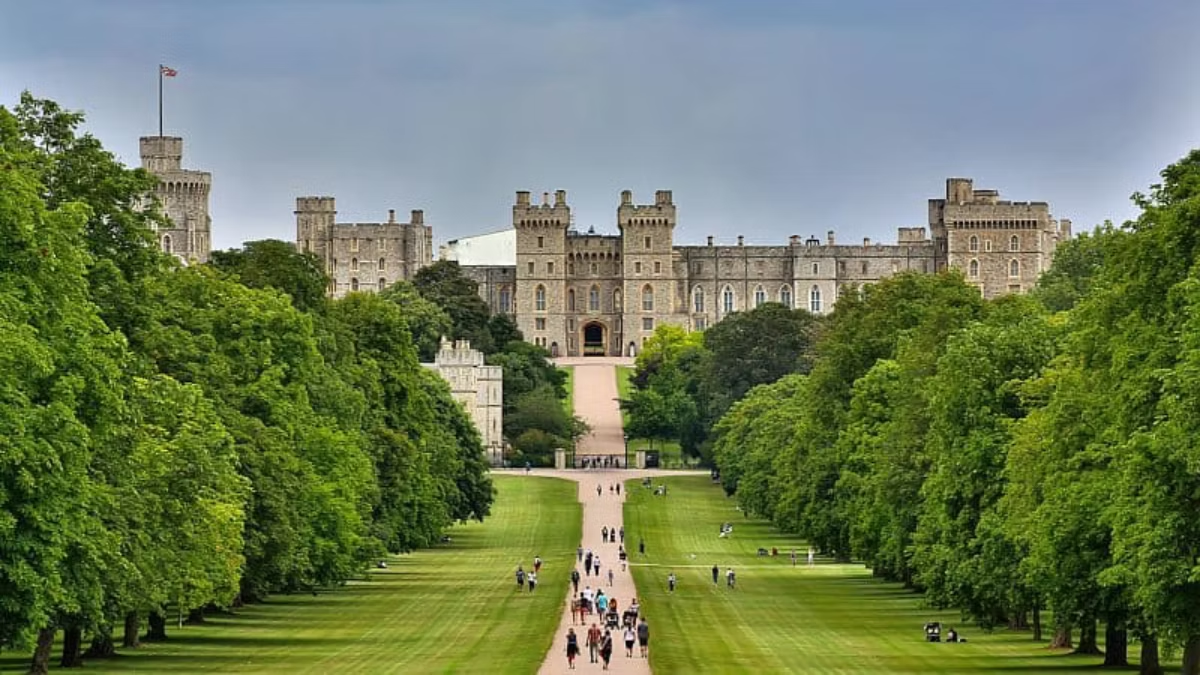
Windsor Castle’s outdoor spaces — the castle precincts — are included with standard admission and cover the Lower Ward, the Middle Ward around the Round Tower, the Quadrangle of the Upper Ward, the North Terrace, the Moat Garden, and the Horseshoe Cloister. Photography is permitted throughout. The Long Walk, which begins just outside the castle gates, is free to access without a ticket. A free 30-minute guided precinct tour is included with admission.
The outdoor spaces of Windsor Castle are often underestimated. First-time visitors tend to focus on the State Apartments and St. George’s Chapel — rightly so — but the castle precincts have their own considerable appeal: the Horseshoe Cloister is among the most photographed medieval buildings in England, the Moat Garden is a surprise of horticultural intimacy tucked beneath the castle walls, and the North Terrace offers one of the finest panoramic views in the Thames Valley. For visitors who enjoy castle architecture as much as interiors, the precincts reward careful exploration.
The Free Precinct Tour
A guided Precinct Tour, led by one of the castle’s wardens, is included with every Windsor Castle admission ticket at no extra charge. Tours depart at half-hourly intervals from the courtyard and last approximately 30 minutes. The warden provides commentary on the castle’s architectural history, the towers, defensive features, and the stories embedded in the outdoor spaces. For visitors who want to understand the physical history of the castle as a fortress, this is one of the most rewarding free extras the visit offers.
Yes. The castle precincts — all outdoor areas within the castle walls — are included with the standard admission ticket. Photography is permitted throughout. A free guided Precinct Tour led by castle wardens is also included and departs at half-hourly intervals.
The Lower Ward
The Lower Ward is the westernmost section of the castle and the area visitors first enter after passing through the Henry VIII Gate. Despite being the lowest in elevation, it contains some of the castle’s most visually striking architecture.
St. George’s Chapel dominates the south side of the Lower Ward — a great Perpendicular Gothic structure with large windows, complex stonework, and a distinctive profile from every angle. The chapel’s exterior is best viewed from the Lower Ward, where its full length is visible.
The Horseshoe Cloister stands immediately west of St. George’s Chapel — a curving, timber-framed and brick cloister built in the 1480s for the vicars choral (the professional singers) of St. George’s Chapel. Its distinctive horseshoe plan, warm red brick, and intricate carved detail make it one of the castle’s most distinctive architectural vignettes and one of the best photography spots in the grounds. At certain times it is still used as residential accommodation for chapel staff.
The Military Knights’ Lodgings line the south wall of the Lower Ward — a terrace of houses built in different periods, ranging from Tudor to Victorian, and still used today by the Military Knights of Windsor. The Military Knights are a small corps of retired army officers who represent the Order of the Garter and march in ceremonial processions at Windsor. Their scarlet uniforms and distinctive Tudor-style hats are a striking sight when they appear in the Lower Ward.
The Curfew Tower stands at the northwest corner of the Lower Ward — the oldest surviving part of the castle walls, built between 1227 and 1230. Its walls are 13 feet thick and it rises 100 feet. The conical French-style roof was added in the 19th century. The tower contains the bells of St. George’s Chapel (placed there in 1478) and the castle clock of 1689, which rings on royal birthdays, major Christian festivals, and state occasions. The tower is not open to general visitors, but its exterior is fully visible from the Lower Ward.
The Henry VIII Gateway — the principal visitor entrance to the castle from Castle Hill — bears the arms of Catherine of Aragon carved into the stonework, a reminder that it was built before Henry VIII’s marriage to Catherine was dissolved.
The Middle Ward: The Round Tower
The Middle Ward is dominated almost entirely by the Round Tower, which sits on its original earthen mound at the castle’s centre. This is the castle’s defining landmark — visible for miles across the Berkshire countryside and the starting point for understanding Windsor’s layered history.
The mound itself is William the Conqueror’s original earthwork from around 1070 — the oldest element of the entire castle complex. Henry II built the first stone tower on the mound in the 1170s. George IV later raised the tower by approximately 30 feet in the 1820s to create a more dramatic Gothic profile; a ring of stone still visible about two-thirds of the way up marks the original height.
The flagpole at the top flies the Royal Standard when the King is in residence and the Union Flag when he is absent. Watching for the flag change on arrival is a minor but genuine pleasure.
The tower interior is not open to general visitors. Walking around the base of the mound through the Middle Ward gives excellent close-up views of the stone tower and an appreciation of its scale.
The Norman Gate — the 14th-century gateway connecting the Middle Ward to the Upper Ward — is worth examining closely as you pass through. Despite its name, it was built by Edward III in the 14th century. The vaulted passageway retains medieval carved lion masks on its stonework, and the portcullis groove is still visible overhead.
The Upper Ward: The Quadrangle and North Terrace
The Quadrangle is the central courtyard of the Upper Ward — a broad, open space surrounded on all sides by the castle’s principal domestic buildings. This is where the Changing of the Guard ceremony takes place when the King is in official residence at Windsor. The equestrian statue of Charles II in the centre of the Quadrangle was placed there by the king himself after the Restoration of the monarchy.
The North Terrace runs along the north side of the castle — a broad stone walkway offering sweeping views across Windsor town, the River Thames, the Eton College playing fields, and the Berkshire and Buckinghamshire countryside stretching to the horizon. On clear days the view extends for many miles. This is one of the finest natural vantage points accessible to the public in the Thames Valley, and one of the best locations within the castle for outdoor photography.
The Moat Garden
The Moat Garden is Windsor Castle’s most intimate outdoor space, tucked into the former dry moat surrounding the Round Tower’s mound. The castle’s original defensive ditch was never filled with water (Windsor uses a dry moat) and has been cultivated as a garden since at least the 17th century.
Today the Moat Garden is a planted herbaceous border rich in seasonal flowers, herbs, and shrubs — a quiet, visually striking contrast to the stone walls and towers surrounding it. In spring and summer, the planting is particularly dramatic. Access to the Moat Garden is included in the admission ticket and it is open during standard castle visiting hours. It is one of the least-crowded spots in the castle grounds and one of the best for close-up photography of the Round Tower from below.
The Three Gardens
Windsor Castle grounds contain three formally maintained gardens:
The Jubilee Garden — Created in 2002 to mark Queen Elizabeth II’s Golden Jubilee. This is the most visible and accessible of the three gardens and is open year-round to visitors.
The East Terrace Garden — A formal garden on the east side of the castle, featuring flower beds, fountains, and views back toward the castle’s private apartments. It is opened to visitors on selected days — typically weekends in summer. Check rct.uk for current access dates.
The Moat Garden — See above. The most distinctive of the three, set in the historic dry moat around the Round Tower.
The Long Walk
The Long Walk is technically outside the castle gates — it begins at the George IV Gateway on the south side of the castle and runs 2.65 miles through Windsor Home Park to the Copper Horse statue of George III on Snow Hill. It is publicly accessible without a ticket.
The avenue was created by Charles II between 1680 and 1685 with rows of elm trees; replanted with plane and chestnut trees after Dutch elm disease destroyed the original planting in the 20th century. Today the walk is lined with 1,652 trees, spaced 9 metres apart, with the avenue between 45 and 63 metres wide.
The view back toward Windsor Castle from the Copper Horse end of the Long Walk is one of the most iconic in England — the castle’s towers rising above the avenue’s vanishing point in a composition that has inspired painters and photographers for three centuries. The walk itself is level and manageable for most visitors.
Photography in the Precincts
Photography for personal, non-commercial use is encouraged throughout all outdoor areas of the castle precincts. The best outdoor photography spots include:
- The Horseshoe Cloister from the Lower Ward — the curved timber facade against the stone of St. George’s Chapel
- The Moat Garden — close-up views of the Round Tower from below the wall line
- The North Terrace — the panoramic view across the Thames Valley
- The Quadrangle — views of the Round Tower and domestic buildings from the central courtyard
- The Long Walk — the classic approach view from outside the castle gates (free, no ticket needed)
- Castle Hill approach — the view up the hill toward the Henry VIII Gate
Frequently Asked Questions
Is the Long Walk included with the Windsor Castle ticket?
The Long Walk is free to access without a ticket. It is public land in Windsor Home Park and open year-round.
What is the Horseshoe Cloister?
A 15th-century curved, timber-framed building in the Lower Ward, built as accommodation for the vicars choral (professional singers) of St. George’s Chapel. It is one of the most architecturally distinctive and frequently photographed buildings in the castle grounds.
Can I see the Moat Garden on every visit?
Yes. The Moat Garden is included with standard admission and is open during normal castle visiting hours. It is located in the former dry moat around the Round Tower.
Is the Round Tower open to visitors?
No. The Round Tower interior is not accessible to general visitors. The exterior and the mound can be viewed from the Middle Ward as part of the standard precinct route.
What is the free Precinct Tour?
A 30-minute guided tour led by a castle warden, included with every admission ticket. Tours depart from the courtyard at half-hourly intervals and cover the castle’s outdoor architectural history.
