

Windsor Castle Accessibility: Everything Disabled Visitors Need to Know
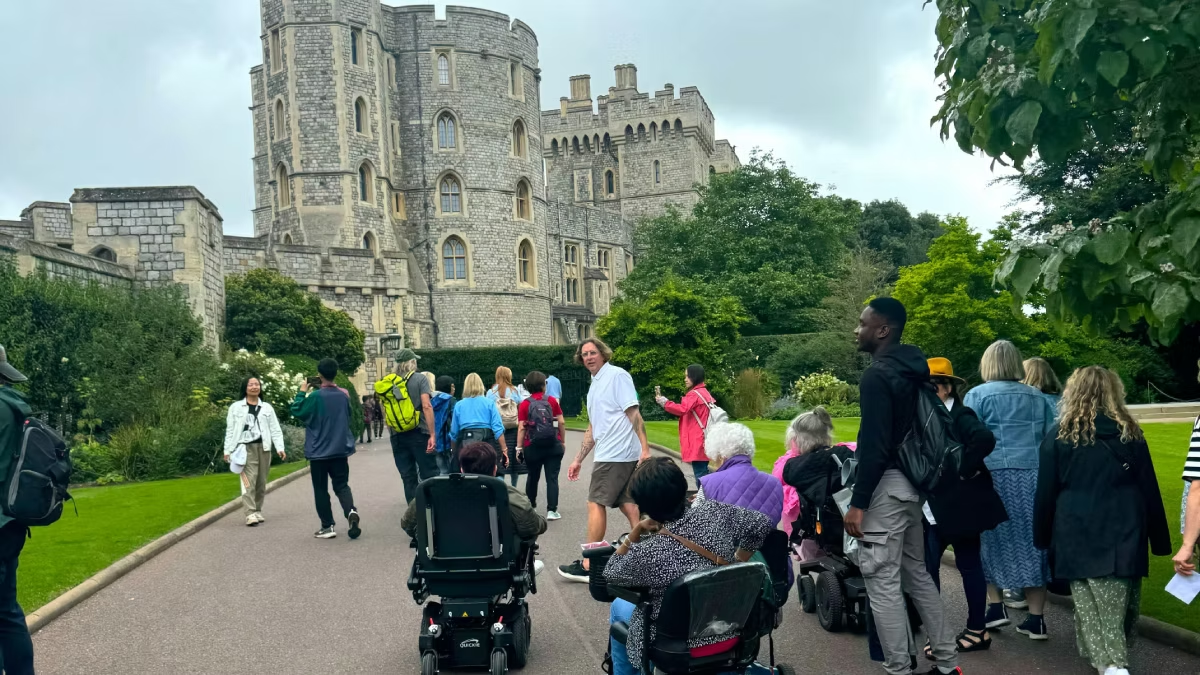
Windsor Castle is fully accessible to wheelchair users, though the site involves a steep hill, long distances, and historic uneven surfaces. The full visitor route can be completed by wheelchair users with staff assistance at key access points. Manual wheelchairs are available to borrow free of charge. A free access companion ticket is available to all disabled visitors, bookable online directly through the Royal Collection Trust. Disabled visitor admission is approximately £16 in advance.
Windsor Castle is committed to accessibility and has invested significantly in making the full visitor route available to disabled visitors. The site’s historic character and steep topography mean that a visit does require planning, but the Royal Collection Trust’s approach — free companion tickets, borrowed wheelchairs, staff assistance at lifts and steps, and a dedicated access information service — is among the more thorough offered by any heritage attraction in England.
This guide covers everything a disabled visitor, carer, or accompanying group member needs to know before planning a visit.
Tickets for Disabled Visitors
Disabled visitor admission: Approximately £16 advance / £18 on the day (compared to £32/£36 for standard adult admission). No proof of disability is required at booking or on entry — visitors self-select the appropriate ticket type.
Free access companion ticket: All disabled visitors are entitled to one free access companion ticket, bookable online through the Royal Collection Trust website at rct.uk. This must be booked in advance through the official website — it is not available through third-party platforms. There is no requirement to demonstrate the nature of your disability.
£1 benefit tickets: Disabled visitors receiving Universal Credit or other named UK benefits can access £1 admission tickets through the official website. Note that £1 tickets cannot be converted to the 1-Year Pass.
Yes. Disabled visitor tickets cost approximately £16 in advance (versus £32 for a standard adult). No proof of disability is required. A free access companion ticket is also available, bookable online at rct.uk — one per disabled visitor. Neither requires documentation.
Wheelchair Access
The full visitor route is accessible by wheelchair. Staff are trained and available to assist at all key access points throughout the visit.
Key points to know:
The approach: Windsor Castle is situated at the top of a steep hill. The walk from Windsor town centre and from either train station involves an uphill gradient. Visitors arriving by car can park in accessible bays at Windsor’s public car parks (Romney Lock, King Edward VII, and Alexandra Gardens are all within approximately 10 minutes of the castle on relatively manageable terrain).
Borrowing a wheelchair: Manual wheelchairs and rollators are available to borrow free of charge on a first-come, first-served basis for the duration of your visit. There is no need to reserve in advance, though arriving earlier in the day reduces the risk that all chairs are already in use.
Motorised wheelchairs and mobility scooters: Permitted in the precinct areas and inside the castle, provided they are compatible with the castle’s lifts. The main lift accessing the State Apartments measures 137cm deep by 100cm wide, with a weight limit of 630kg. Visitors may be asked to transfer from a mobility scooter to a castle wheelchair to access some areas.
Shopmobility hire: A Shopmobility service operated by People to Places is available at the Alma Road Coach Park, approximately 5–10 minutes from the castle entrance. Electric scooters, powered and manual wheelchairs, and manual walkers are available to hire by the day. Free parking in the Alma Road Car Park is included with Shopmobility hire. Visit the People to Places website or contact them directly to book.
Golf buggy: In extreme cases where a visitor cannot manage the distances involved in the castle precinct, a golf buggy is available to transport visitors. Ask a member of staff on arrival.
Flooring and surfaces: Most interior rooms are carpeted with thick-pile carpet or polished wooden floors. Some areas of the castle grounds are cobbled and uneven. St. George’s Chapel has stone floors. Historic buildings mean that surfaces may be uneven — exercise appropriate care.
Seating: Bench seating is available at regular intervals in the precincts. Limited seating is available inside the State Apartments upon request. Seating is available in the nave of St. George’s Chapel.
Lifts and Step-Free Routes
The castle route includes several sets of steps, but step-free alternatives exist throughout:
- There are 9 steps up to the main State Apartments entrance door, followed by a further 11 steps inside. A platform lift on the North Terrace provides the step-free alternative — staff will direct you to it on request.
- Lifts inside the castle require assistance from warden staff as they are not on the main visitor route. Always approach a member of staff to request lift access — do not attempt to find them independently.
- The route to St. George’s Chapel involves paths in the Lower Ward of the castle precincts — broadly manageable by wheelchair but with some gradient.
Accessible Toilets
Accessible toilets are located at three points during the visitor route: 1. After the Security Hall, near the start of your visit 2. On the North Terrace, before the entrance to the State Apartments 3. After exiting the State Apartments, near the Inner Hall
Accessible toilets are locked with a RADAR key. If you do not have your own key, ask a member of staff to unlock them. The Changing Places facility is located in Engine Court — ask a member of staff for directions.
Visitors with Visual Impairments
Descriptive audio guide: A descriptive audio tour of the castle is available for blind and partially-sighted visitors — a different and richer version of the standard multimedia guide. Collect it from the audio guide distribution point.
Pre-bookable descriptive tour: Blind and partially-sighted visitors can pre-book a guided descriptive tour with a Vocaleyes-trained guide. Contact the Royal Collection Trust Specialist Sales team on +44 (0)303 123 7324 or email [email protected] to arrange.
Visitors Who Are D/Deaf or Hard of Hearing
BSL tours: Regular British Sign Language guided tours are offered throughout the year. Check the Royal Collection Trust’s What’s On section at rct.uk/whatson/windsor for current dates.
Audio guide adaptations: The standard multimedia audio guide is available with subtitles. A plain English script of the audio tour is also available to borrow from the admission centre — useful for visitors who prefer to read the content rather than listen.
Hearing loops: Please enquire at the admission centre — some staff have basic BSL communication ability.
Visitors with Hidden Disabilities and Dementia
Several wardens hold Dementia Friends status and can provide additional support to visitors living with dementia and their carers. Windsor Castle also holds dementia-friendly morning events on selected dates throughout the year — check the What’s On calendar at rct.uk for current events.
Visitors with hidden disabilities (including autism, anxiety, and other conditions that may affect queuing or crowded environments) should speak to staff at the Admission Centre on arrival. During busy summer and Christmas periods, staff can offer seating or fast-track admission where possible to visitors who find standing or queuing difficult.
Assistance Dogs
Registered assistance dogs are welcome throughout Windsor Castle, including inside all buildings. Dogs should wear their designated jacket or lead slip to identify them as working animals. A water bowl is available on request. Staff may ask visitors to remove their animal if it is not behaving appropriately — arrangements will be made for the visitor to return without the animal if necessary.
Non-registered dogs and emotional support animals may be admitted at the discretion of staff on a case-by-case basis. Due to conservation concerns, entry cannot be guaranteed.
Practical Tips for Planning Your Visit
Contact the Specialist Sales team before your visit if you have complex access requirements — they can advise on the most suitable route, pre-book a descriptive tour, arrange accessible parking, and answer specific questions. Telephone +44 (0)303 123 7324 or email [email protected].
Use the AccessAble guide: Detailed room-by-room access information, including dimensions, surface types, step counts, and photographs, is available on the AccessAble website (accessable.co.uk/windsor-castle) and via the AccessAble app. This level of detail goes beyond what is summarised here and is strongly recommended for visitors planning a visit around specific access requirements.
Plan for longer than average. The accessible route, including the use of lifts and staff-assisted access points, takes longer than the standard route. Allow at least 3 hours if using a wheelchair or requiring staff assistance at steps and lifts.
Arrive earlier rather than later. Borrowed wheelchairs are available on a first-come, first-served basis. Staff assistance at lifts is dependent on warden availability. Visiting at quieter times — weekday afternoons, or winter months — makes the experience more manageable.
Frequently Asked Questions
Is Windsor Castle wheelchair accessible?
Yes. The full visitor route can be completed by wheelchair users, with staff assistance at key lift and step-access points. Manual wheelchairs are available to borrow free of charge. The site involves a steep approach hill, long distances, and some uneven historic surfaces — plan accordingly.
Is there a free ticket for carers at Windsor Castle?
Yes. A free access companion ticket is available for all disabled visitors. It must be booked online in advance at rct.uk — it cannot be purchased on the day or through third-party platforms. No proof of disability is required.
Do I need to prove my disability to get the disabled visitor ticket?
No. Windsor Castle does not require proof of disability for either the discounted disabled visitor ticket or the free access companion ticket. Visitors self-select the appropriate ticket at booking.
Are there BSL tours at Windsor Castle?
Yes. Regular British Sign Language tours are offered throughout the year. Check the Royal Collection Trust’s What’s On calendar at rct.uk/whatson/windsor for current dates and booking information.
Are assistance dogs allowed inside Windsor Castle?
Yes. Registered assistance dogs wearing their designated jacket or lead slip are welcome throughout the castle, including inside all buildings. A water bowl is available on request.
Where can I find the most detailed accessibility information for Windsor Castle?
The most detailed room-by-room access guide is available at accessable.co.uk/windsor-castle — including surface types, step counts, door widths, and photographs of every part of the visitor route. For personalised advice, contact the Specialist Sales team on +44 (0)303 123 7324.
