

Queen Mary's Dolls' House: The World's Most Famous Miniature Palace
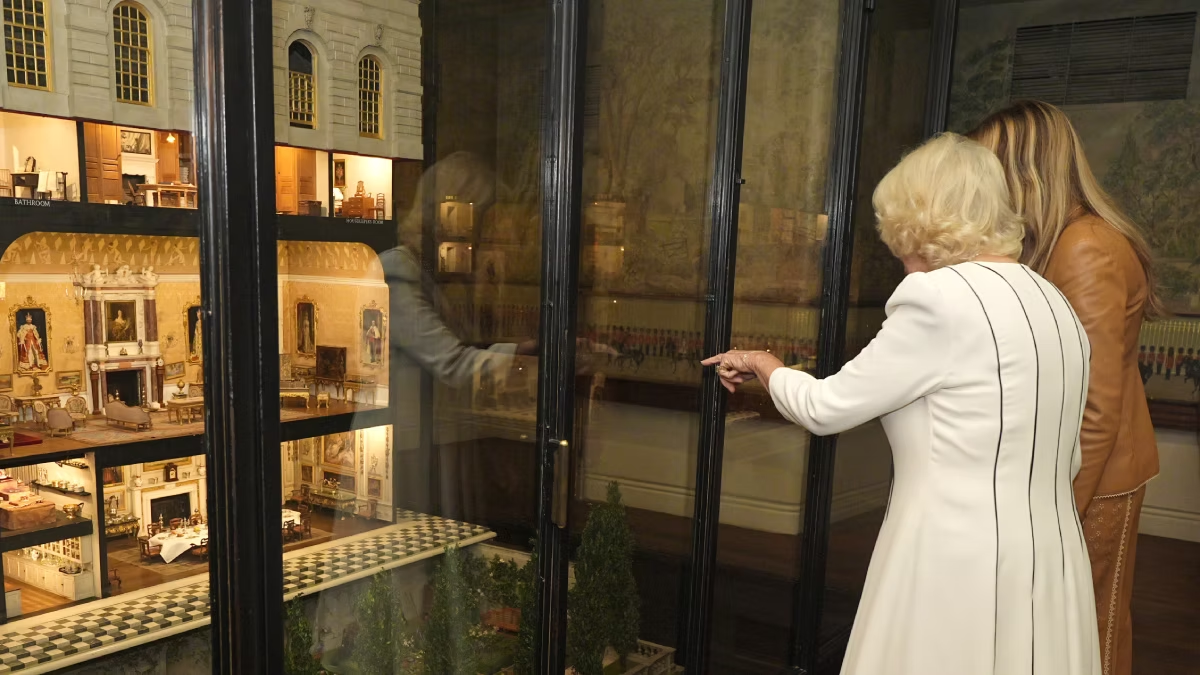
Queen Mary’s Dolls’ House is a 1:12 scale miniature palace built between 1921 and 1924, designed by architect Sir Edwin Lutyens with contributions from over 1,500 artists, craftspeople, and manufacturers. It has working electricity, running water, flushing toilets, and working lifts. The library contains original miniature books written by 170 authors of the day. It is included with every Windsor Castle admission ticket and displayed in a specially designed room within the State Apartments. Almost every visitor spends longer here than they expected.
Queen Mary’s Dolls’ House is one of those attractions that visitors underestimate until they are standing in front of it. It is not a toy and was never intended as one. It is a 1:12 scale document of a specific moment in English life — 1920s aristocratic Britain — executed with a level of craftsmanship and detail that took four years and the contributions of some of the finest artists and artisans of the age. More than 1.6 million people came to see it at the British Empire Exhibition of 1924–25 before it was moved to Windsor Castle, where it has been on display ever since.
History and Origins
The idea for Queen Mary’s Dolls’ House came from Queen Mary’s cousin, Princess Marie Louise, who discussed it with the architect Sir Edwin Lutyens at the Royal Academy Summer Exhibition in 1921. Lutyens agreed to design the house, and Princess Marie Louise began writing — by hand — around 2,000 letters to leading artists, craftspeople, and manufacturers of the period, asking them to contribute work.
The concept was to create a perfect record of a 1920s royal residence in miniature: not a fantasy, but a realistic, fully functional representation of how such a house would actually work and be equipped. Every object was made at 1:12 scale — one inch to one foot — and was to be as accurate and functional as the full-size original.
Construction took from 1921 to 1924. The completed house was first exhibited at the British Empire Exhibition at Wembley in 1924–25, where it drew over 1.6 million visitors and raised funds for Queen Mary’s charitable causes. In July 1925 it was moved to Windsor Castle, where it was placed in a specially designed room — itself designed by Lutyens — decorated with architectural motifs and murals. It has remained there ever since.
It is a 1:12 scale miniature palace designed by Sir Edwin Lutyens, built 1921–1924 for Queen Mary, consort of King George V. It has working electricity, running water, flushing toilets, and working lifts. Its library holds miniature books written by 170 authors including Arthur Conan Doyle and A.A. Milne. It is included with every Windsor Castle admission ticket and on permanent display at Windsor Castle.
The Scale and Structure
The house is built at 1:12 scale — every inch represents one foot in the full-size world. It stands over three feet tall and is displayed behind a large glass cabinet. The facade can be lifted to reveal the detailed interiors, which are arranged across three main floors above a basement.
The house contains approximately 40 rooms across the main floors. The east side of the house faces a garden — a fully planted miniature garden that emerges from a drawer in the basement. The entire structure represents an English aristocratic residence of the 1920s, with both “upstairs” public rooms and “downstairs” service spaces.
What’s Inside: Room by Room
The Library
The most celebrated room in the Dolls’ House. The library was supplied with miniature books by 170 authors of the day, each of whom contributed an original work — complete and fully legible, despite being no larger than a matchbox. Authors who contributed include Sir Arthur Conan Doyle, A.A. Milne (creator of Winnie-the-Pooh), Rudyard Kipling, Thomas Hardy, M.R. James, and many other leading literary figures of the early 20th century. The books are handwritten in the authors’ own hand and bound in full-size styles. Seven hundred miniature paintings were also contributed by artists for folios in the library (these artworks are now kept in the Print Room at Windsor Castle for conservation reasons).
The library also contains a miniature globe, leather-bound chairs, a working clock, and a fireplace.
The Wine Cellar and Pantry
The basement contains a fully stocked wine cellar with miniature bottles containing real wine — Château Pichon-Longueville and other actual vintage wines, bottled and sealed in proportion. The cellar also contains miniature casks. A pantry equipped for a royal kitchen completes the basement service area.
The Dining Room
Set for eighteen guests with a silver dinner service by Garrard & Co. and crystal glasses by Webb’s. The table is fully laid, with miniature settings that include real silver cutlery and correct period tableware. The dining room walls are hung with miniature paintings by noted artists of the period.
The King’s and Queen’s Suites
The private apartments on the upper floors contain miniature four-poster beds, dressing tables, wardrobes, and personal items — including a miniature camera, a miniature gramophone, and family photographs in frames. The attention to personal detail throughout these rooms is remarkable: the wardrobes contain miniature clothing, the dressing tables have functioning miniature bottles of perfume and powder boxes.
The Bathrooms
The bathrooms are fully plumbed. The hot and cold taps work, delivering real water. The lavatories flush. The miniature lavatory paper is correctly scaled. This level of working functionality throughout the house was a deliberate statement of technical ambition — Lutyens intended the house to demonstrate the full capabilities of British craftsmanship.
The Garage
The basement garage houses a fleet of miniature cars — including models of the Daimler and other vehicles used by the Royal Family — with functioning engines. The cars were made to the same 1:12 scale as everything else in the house.
The Garden
A miniature garden emerges from a drawer at basement level on the east side of the house, planted and maintained to match the scale of the building. Even the lawn furniture and garden tools are correctly proportioned.
The Kitchen
The kitchen is equipped for a full-scale royal household kitchen, with miniature copper pans, a cook’s range, and kitchen equipment — everything a real kitchen of the period would contain, at 1:12 scale.
The Craftsmanship
Over 1,500 artists, craftspeople, and manufacturers contributed to the house. The project was, in effect, a commission to the entire creative and manufacturing sector of early 1920s Britain. The contributors worked at an extraordinary level of precision:
- Carpets and curtains were woven on specially miniaturised looms
- Locks and door furniture were made by silversmiths and locksmiths
- The silver dinner service was produced by Garrard, the Crown Jewellers
- The miniature cars have working engines, made by the same engineers who built the full-scale vehicles
- The books’ bindings were made by bookbinders using period-appropriate materials
Many manufacturers provided the house with their actual products at miniature scale — effectively making it a showcase of British manufacturing at its peak, as well as a royal residence.
What Makes It Worth Seeing
Visitors who arrive with mild expectations consistently spend 20–30 minutes at the Dolls’ House rather than the 5 they planned. The specific quality that compels attention is not the size but the completeness: every object is present, every system works, and the whole represents an entire world in which nothing has been simplified or omitted. The accumulated effect of this completeness — seeing a flushing lavatory the size of a thimble, a library of books you could read with a magnifying glass, a garage of cars with working engines — produces a response that is difficult to categorise but unmistakable when you experience it.
Children are fascinated by it. Adults who expected not to be fascinated are fascinated. It is one of the few attractions in England that consistently exceeds expectations rather than meeting them.
Practical Information
Entry: Included with every Windsor Castle admission ticket. No separate ticket required.
Location: Housed in a specially designed room within the State Apartments route — you encounter it as part of the standard visitor route, before or adjacent to the main State Apartments.
Photography: Not permitted inside the Dolls’ House room (same rule as the rest of the State Apartments).
Time to allow: 20–30 minutes — most visitors stay longer than planned. Factor this into your overall visit timing.
Accessibility: Step-free access is available via a platform lift from the North Terrace for wheelchair users.
Viewing: The house is displayed behind glass. The facade can be lifted to reveal the interiors. Viewing is from the front and sides only.
Frequently Asked Questions
Is Queen Mary’s Dolls’ House included in the Windsor Castle ticket?
Yes. Entry to the Dolls’ House is included with every standard Windsor Castle admission ticket at no extra charge.
Who was Queen Mary?
Queen Mary (1867–1953) was the consort of King George V and grandmother of Queen Elizabeth II. She was known for her love of collecting antiques and miniatures, and for her role supporting Britain during the First World War — the period that inspired the Dolls’ House as a celebratory project.
Are the books in the library really legible?
Yes. Each miniature book in the library was written by hand in the contributing author’s own handwriting and is fully legible, though very small. The texts are original works created specifically for the house.
Does the house really have working electricity?
Yes. The house has a working electrical system — the lights in each room function. It also has hot and cold running water, flushing toilets, and working lifts.
How long did it take to build?
Construction took approximately three years, from 1921 to 1924. The coordination of contributions from over 1,500 craftspeople and manufacturers made it one of the most complex collaborative projects in 20th-century British decorative arts.
