

St. George's Chapel: A Complete Visitor Guide
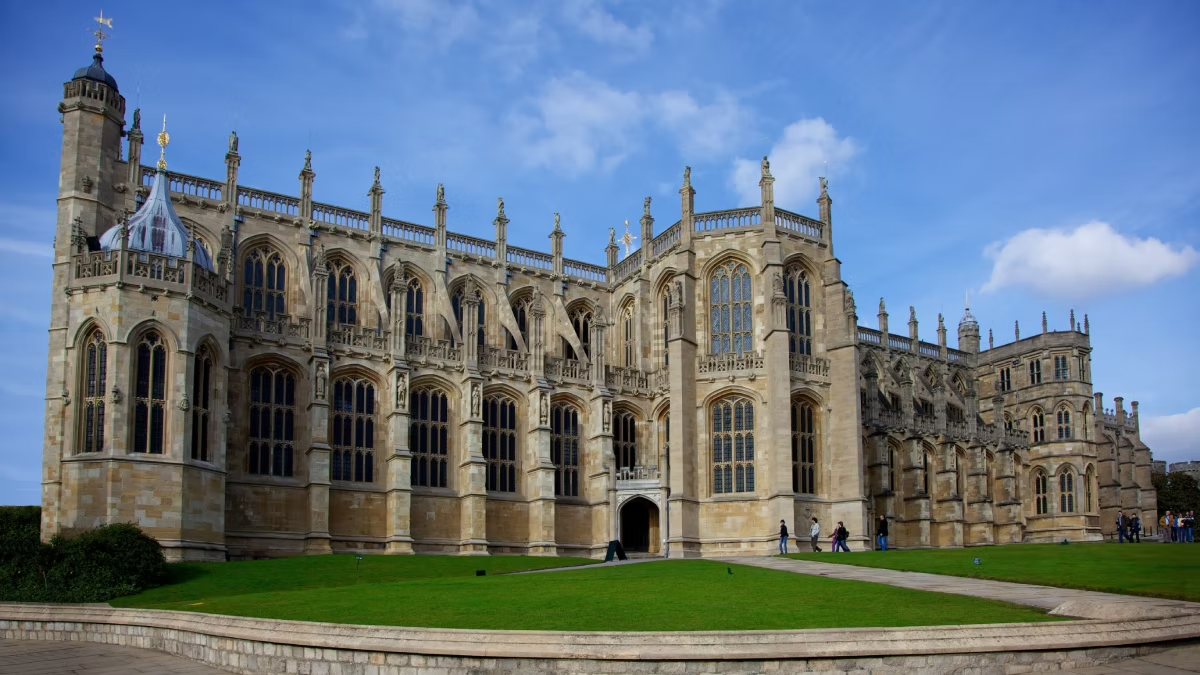
St. George’s Chapel is included with Windsor Castle admission and is one of England’s finest Gothic buildings. It is the burial place of 11 monarchs including Queen Elizabeth II, Henry VIII, and Charles I. The chapel is located in the Lower Ward and closes at 16:00 on weekdays. It is closed to general visitors on Sundays (but open for free worship services). Visit it first on arrival — it is the most time-critical element of any Windsor Castle visit.
St. George’s Chapel is one of the most historically layered sacred spaces in England. Built between 1475 and 1528 in the Perpendicular Gothic style, it is simultaneously a royal mausoleum holding 11 monarchs, the spiritual home of the Order of the Garter, an active place of daily worship, and one of the most architecturally accomplished buildings of medieval England. Visitors who expect a brief side-visit often find themselves staying for 30 to 40 minutes.
Tickets & Entry
St. George’s Chapel is included in the standard Windsor Castle admission ticket at no extra charge. No separate ticket is required. It is open to general visitors on Monday, Thursday, Friday, and Saturday. It is closed to general visitors on Sundays, when it is open for worship only.
Important timing note: St. George’s Chapel closes at 16:00 on weekdays (last entry approximately 15:45). If you spend time in the State Apartments before visiting the chapel, you risk finding it closed. Visit St. George’s Chapel first — immediately on arrival. The State Apartments are open until the castle’s main closing time; the chapel is not.
Free attendance at services: All are welcome to attend chapel services free of charge, without a Windsor Castle admission ticket. The main daily Evensong service takes place at 17:15 — queue at the Henry VIII Gate (the visitor exit from the castle) no later than 15 minutes before the service begins. Attending Evensong, sung by the professional choir of St. George’s Chapel, is one of the most memorable free experiences available anywhere in the Windsor area.
Yes. St. George’s Chapel is included with every standard Windsor Castle admission ticket at no extra charge. It is open to visitors on Monday, Thursday, Friday, and Saturday, and closes at 16:00 on weekdays. On Sundays it is closed to general visitors but open for free worship services. Visit it first on arrival.
The Architecture
St. George’s Chapel is widely regarded as one of the supreme achievements of English Perpendicular Gothic architecture. The historian John Martin Robinson described it as “one of the supreme achievements of English Perpendicular Gothic” design.
Perpendicular Gothic is a distinctively English architectural style of the 15th and early 16th centuries, characterised by strong vertical lines, large windows flooding the interior with light, slender pillars, and elaborate fan vaulting. Windsor’s chapel exemplifies all of these qualities.
The Fan Vaulting The most immediately striking feature of the interior is the magnificent fan vaulting over the nave. This stone ceiling — in which ribs spread outward from the pillars like the ribs of a fan — was completed under Henry VIII in the 1520s. The vaulting over the crossing (the intersection of the nave and choir transepts) was added last, in 1528, completing the chapel. Look up immediately on entering — the vaulting overhead is the chapel’s single most impressive architectural element.
The Nave The nave is the long central space of the chapel through which visitors first walk. Tall slender pillars support the vaulted ceiling, and large windows on both the north and south walls flood the interior with light. The west window at the far end of the nave, completed in 1509, depicts 75 royals, saints, and popes in stained glass.
The Quire Beyond the ornate choir screen that separates the nave from the inner chapel, the Quire is the formal ceremonial space where royal events take place — weddings, funerals, and the annual Garter Service. The carved wooden stalls of the Knights and Ladies of the Garter line both sides of the Quire. Each stall is surmounted by the stall-holder’s helmet, sword, and heraldic banner. Brass plates below each stall record every Knight or Lady of the Garter since the Order was founded in 1348.
The Choir Screen The choir screen — which separates the public nave from the liturgical Quire — is a masterwork of 15th-century carved stonework. Its delicate decoration of flowers, foliage, and heraldic motifs is among the finest surviving examples of English medieval stonework. The screen was retained when the chapel was modified in subsequent centuries and remains substantially in its original form.
The Royal Tombs
St. George’s Chapel is the burial place of 11 British monarchs — a greater number than any other royal chapel in England except Westminster Abbey. The tombs are distributed throughout the chapel.
Queen Elizabeth II and the King George VI Memorial Chapel
The King George VI Memorial Chapel opens off the north choir aisle and is the most visited part of the chapel for contemporary visitors. It contains:
- Queen Elizabeth II (died 8 September 2022) — buried beneath a black ledger stone inscribed simply with her name and dates. The burial took place in a private interment service on 19 September 2022.
- Prince Philip, Duke of Edinburgh (died 9 April 2021) — buried alongside the Queen.
- King George VI (died 6 February 1952) — Elizabeth II’s father and the previous monarch.
- Queen Elizabeth The Queen Mother (died 30 March 2002).
- Princess Margaret (died 9 February 2002).
Visitors wishing to pay their respects at Queen Elizabeth II’s tomb can do so on any day the chapel is open to general visitors (Monday, Thursday, Friday, Saturday) — not on Sundays.
Henry VIII and Charles I
In the centre of the Quire, beneath a black slab, lie Henry VIII (died 1547) and Jane Seymour (died 1537). Charles I, executed for treason in 1649, was buried alongside them after his execution. Three of the most dramatic figures in English royal history share a single vault — two of them historically controversial in very different ways.
Other Royal Burials
- Edward IV (died 1483) — the king who began building the present chapel, buried in a side chapel at the east end.
- Henry VI (died 1471, murdered) — buried in the south choir aisle near the high altar. His tomb was the site of reported miracles in the medieval period, making it briefly a pilgrimage destination.
- Edward VII and Queen Alexandra — buried in a side chapel near the north choir aisle.
- George V and Queen Mary — also buried at Windsor.
- George VI (see King George VI Memorial Chapel above).
- The Royal Vault beneath the Quire (not publicly accessible) contains George II, George IV, and William IV, along with other members of the royal family.
Edward III’s Battle Sword
Hanging in the south choir aisle is the great battle sword made for King Edward III — an extraordinary relic measuring approximately 6 feet 8 inches (2 metres) in length. One of the oldest surviving royal artefacts in the chapel.
The Order of the Garter
St. George’s Chapel is the spiritual home of the Order of the Garter, founded by Edward III in 1348 — the oldest chivalric order in Britain. The Order has 26 members: the sovereign, the Prince of Wales, and 24 additional members appointed personally by the monarch for outstanding service.
Every June, the Sovereign and the Knights and Ladies of the Garter gather at Windsor Castle for the annual Garter Day. After lunch in the State Apartments, they process in their distinctive dark blue robes and plumed hats through the castle and down to St. George’s Chapel for the service of thanksgiving. The procession, which winds through the Lower Ward, is a spectacular ceremonial occasion and a rare opportunity to see the Garter Knights in their robes.
Each Garter stall in the Quire is assigned to a specific Knight or Lady. When they die, their personal insignia — sword, helmet, crest, and banner — are removed from the stall, but the brass plate recording their arms remains. The cumulative effect of hundreds of brass plates recording every Garter Knight since the 14th century makes the Quire a remarkable visual record of English and British history.
Royal Weddings in St. George’s Chapel
The chapel has been the venue for several notable royal weddings in recent decades:
- Prince Harry and Meghan Markle (2018) — watched by millions worldwide, the most widely broadcast royal wedding in the chapel’s history.
- Princess Eugenie and Jack Brooksbank (2018) — later in the same year.
- Prince Edward and Sophie Rhys-Jones (1999).
- Prince Charles and Camilla Parker Bowles (2005) — a blessing service at the chapel following a civil ceremony.
Practical Information
Opening days for general visitors: Monday, Thursday, Friday, Saturday
Closing time: 16:00 (last entry approximately 15:45). Plan to visit the chapel first on arrival — do not leave it until after the State Apartments.
Closed to visitors on Sundays: The chapel is open for worship only on Sundays. All worshippers are welcome to attend services free of charge.
Photography: Not permitted inside St. George’s Chapel.
Access: Step-free access is available; ask staff for directions to the accessible route.
Attending services (free, no castle ticket required): Evensong is held daily at 17:15. Queue at the Henry VIII Gate (visitor exit) no later than 15 minutes before the service. Attending from the nave is free; seating in the Quire may be available if space permits. Check the chapel’s website (stgeorges-windsor.org) for the current service schedule and music list.
Frequently Asked Questions
Where is Queen Elizabeth II buried?
In the King George VI Memorial Chapel, which opens off the north choir aisle of St. George’s Chapel, Windsor Castle. Her grave is a black ledger stone alongside Prince Philip, her father George VI, her mother, and her sister Princess Margaret.
Can I attend a service at St. George’s Chapel without a Windsor Castle ticket?
Yes. Chapel services are free and open to all. The main daily Evensong service is at 17:15. Queue at the Henry VIII Gate no later than 15 minutes before the service.
Is St. George’s Chapel open on Sundays?
Closed to general visitors. Open for worship services only. If seeing the chapel and Queen Elizabeth II’s burial place is important to your visit, choose a Monday, Thursday, Friday, or Saturday.
Why should I visit St. George’s Chapel before the State Apartments?
The chapel closes at 16:00 on weekdays — significantly earlier than the main castle closing time. If you visit the State Apartments first, you risk finding the chapel closed when you reach it. Visit the chapel immediately on arrival.
Are the royal tombs accessible in the Quire?
The Quire itself is accessible to visitors. The Royal Vault beneath the floor of the Quire is sealed and not publicly accessible. Visitors can see the floor markers identifying where Henry VIII, Charles I, and others lie.
