

Windsor Castle Facts: 25 Things Worth Knowing Before You Visit
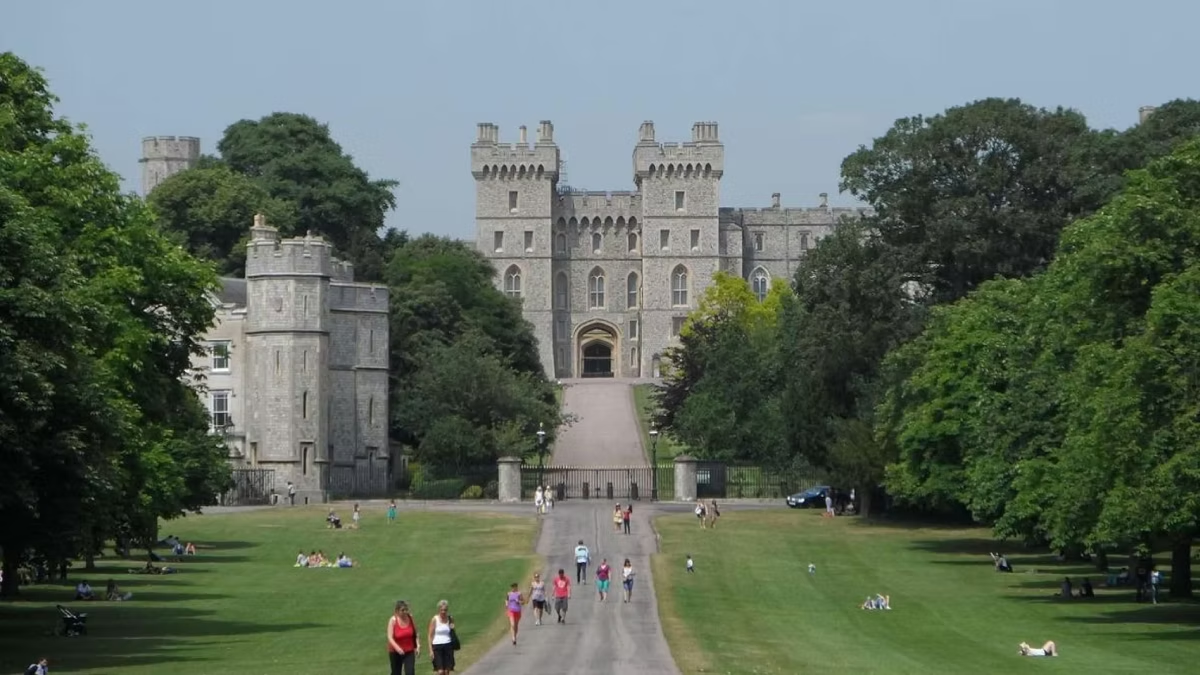
Windsor Castle was founded circa 1070 by William the Conqueror, covers 13 acres, has approximately 1,000 rooms, and has been the home of 40 monarchs over nearly 1,000 years. It is the oldest and largest occupied castle in the world. Queen Elizabeth II lived there from 2011 until her death in September 2022 and is buried in St. George’s Chapel. The castle has 300 fireplaces, over 450 clocks, and the oldest continuously operating royal kitchen in the country.
Windsor Castle is one of the most historically layered buildings on earth — not simply a preserved monument but an active royal residence, still in use, still changing. The facts below cover its founding, its monarchs, its architectural curiosities, its remarkable domestic details, and the stories that give it a character unlike any other heritage site.
25 Windsor Castle Facts
1. It is the oldest occupied castle in the world. Windsor Castle has been continuously occupied by the English and British royal family since 1110 — when Henry I, son of William the Conqueror, first used it as a residence. No other castle on earth has been continuously inhabited for so long.
2. It was built as a fortress, not a home. William the Conqueror built Windsor around 1070 as one of nine defensive castles in a ring around London, each placed roughly 25 miles apart — one day’s march from the city. Its position above the River Thames gave it control over a strategically vital stretch of water.
3. The original structure was made of wood. The first Windsor Castle was a motte-and-bailey construction — an earthen mound with a wooden keep and a surrounding wooden stockade. The stone fortifications that visitors see today began with Henry II in the 1170s.
4. 40 monarchs have lived here. Since Henry I first made it a residence, every subsequent English and British monarch has used Windsor Castle — 40 in total. No other building in Britain can claim continuous royal occupation across so many successive reigns.
5. The castle covers 13 acres. The castle grounds cover 13 acres (approximately 5.3 hectares) — the equivalent of around 269 tennis courts. The wider Windsor estate, including Windsor Great Park, covers 4,800 acres.
6. It has approximately 1,000 rooms. Windsor Castle contains approximately 1,000 rooms within its walls, making it one of the largest residential buildings in the world. Visitors on a standard ticket access a carefully managed fraction of these.
7. The Royal Family changed their name because of Windsor. During the First World War, anti-German sentiment made the royal family’s German surname — Saxe-Coburg-Gotha — politically untenable. In 1917, King George V changed the family name to Windsor, after the castle. Unusually in royal nomenclature, the building gave its name to the dynasty rather than the other way around.
8. Queen Elizabeth II was born at Windsor and died at Windsor. Queen Elizabeth II spent much of her childhood at Windsor Castle during the Second World War, where she and Princess Margaret sheltered as London was bombed. She died at Windsor on 8 September 2022, and is buried in the King George VI Memorial Chapel within St. George’s Chapel.
9. St. George’s Chapel is the burial place of 11 monarchs. St. George’s Chapel, built between 1475 and 1528, contains the tombs of 11 British sovereigns: Edward IV, Henry VI, Henry VIII, Jane Seymour, Charles I, King George III (in St. George’s), King George IV, William IV, King George V, King George VI, and Queen Elizabeth II.
10. Henry VIII is buried here. Henry VIII — one of the most famous monarchs in English history — is interred at Windsor alongside his third wife and only son’s mother, Jane Seymour. He specifically chose Windsor for his burial.
11. Charles I, who was executed for treason, is buried here too. Charles I was the only English monarch to be tried and executed by his own parliament. After his execution in 1649, his body was brought to Windsor and interred in St. George’s Chapel alongside Henry VIII — a peculiar historical proximity.
12. The castle has 300 fireplaces. Windsor Castle contains 300 working fireplaces throughout its buildings. A specialist craftsman known as the King’s fendersmith is responsible for all 300, having taken over the role from his father in 1984. Each fireplace must be cleaned and prepared to the standard required for a royal residence.
13. There are over 450 clocks. The castle contains more than 450 clocks. The task of adjusting them for British Summer Time takes approximately 16 hours and requires a dedicated team of horologists (clock specialists). The clocks in the Great Kitchen are always kept five minutes fast to ensure that food is never served late.
14. The Great Kitchen is the oldest working royal kitchen in England. The Great Kitchen at Windsor has been in continuous operation since the reign of Edward III in approximately 1360 — over 660 years. It has served 33 of Britain’s 40 monarchs and remains an operational royal kitchen today, staffed by chefs and kitchen workers who prepare food for royal guests and events.
15. It took 250 firefighters 15 hours to extinguish the 1992 fire. On 20 November 1992 — coincidentally the 45th wedding anniversary of Queen Elizabeth II and Prince Philip — a fire broke out in the Private Chapel of Windsor Castle. It spread rapidly and destroyed or severely damaged over 100 rooms. It took 250 firefighters and approximately 1.5 million gallons of water to bring under control. The five-year restoration was completed in 1997 at a cost of approximately £37 million, much of it raised by opening Buckingham Palace to summer visitors.
16. Most of the great artworks were saved from the fire. Many rooms were under renovation at the time of the fire and their contents had been moved. This means that most of the irreplaceable paintings, furniture, and objects were not in the affected areas and survived undamaged.
17. The Round Tower is not actually round. Despite its name and near-circular appearance, the Round Tower has a square southern side. It was built in the 1170s by Henry II on the original earth mound created by William the Conqueror. George IV later raised the tower by approximately 30 feet to improve the castle’s dramatic silhouette and satisfy his taste for the Gothic aesthetic.
18. The flagman watches through binoculars to time the Royal Standard. When the King arrives at Windsor Castle, a dedicated flagman climbs to the top of the Round Tower. He watches through binoculars and hoists the Royal Standard — the monarch’s personal flag — at the precise moment the King passes through the castle gates. When the King is absent, the Union Flag flies instead.
19. The Long Walk is 2.65 miles long and has 1,652 trees. The tree-lined avenue leading from the George IV Gateway to the Copper Horse statue on Snow Hill in Windsor Great Park was created by Charles II between 1680 and 1685. It is planted with 1,652 trees, spaced 9 metres apart, with the rows between 45 and 63 metres apart.
20. The castle estate has over 450 clocks — and it takes two days to lay the State Banquet table. It takes 8 to 10 people two full days to lay the table for a State Banquet in St. George’s Hall. Each guest is allocated exactly 46cm of table space. Up to 160 guests can be accommodated at a single State Banquet.
21. Windsor Castle survived the Second World War because Hitler wanted to keep it. A widely reported story — though impossible to fully verify — holds that Windsor Castle and the town of Windsor were never targeted during the Luftwaffe bombing campaigns because Adolf Hitler intended to keep the castle as his own residence following a successful invasion of Britain. Whatever the reason, both the castle and the town emerged from the war largely undamaged.
22. The Royal Library contains original drawings by Leonardo da Vinci, Michelangelo, and Raphael. The Royal Library, housed in the castle’s Upper Ward, contains thousands of works on paper including original drawings by Leonardo da Vinci, Michelangelo, Raphael, and Holbein — among the most significant private collections of drawings in the world. Selected works are displayed in the Drawings Gallery within the castle.
23. The Order of the Garter was inspired by King Arthur. The Order of the Garter — the oldest and most senior order of chivalry in Britain, established by Edward III in 1348 — was reportedly inspired by Edward’s fascination with the legend of King Arthur and his Knights of the Round Table. Windsor Castle has been its spiritual home ever since. The Knights’ and Ladies’ heraldic banners hang in St. George’s Chapel.
24. The castle gave its name to the Battle of Windsor during the First Barons’ War. In 1216, Windsor Castle was besieged for three months by rebel barons opposed to King John. The siege was ultimately unsuccessful — the castle held — and represents one of the first significant military tests of the castle’s defensive design.
25. The Undercroft Café sits in a medieval cellar that stored the castle’s wine for centuries. The café where visitors can stop for tea and cake during their visit occupies the undercroft beneath St. George’s Hall — a medieval vaulted space that served as Windsor Castle’s main wine cellar from the reign of Edward III in the 14th century until its conversion into a visitor café in 2020.
Frequently Asked Questions
How old is Windsor Castle?
Windsor Castle was founded circa 1070 by William the Conqueror, making it approximately 955 years old. It has been a royal residence since 1110, when Henry I first used it as a home.
How many monarchs have lived at Windsor Castle?
40 monarchs have called Windsor Castle home, from Henry I to King Charles III.
How many rooms does Windsor Castle have?
Approximately 1,000 rooms. Standard visitors access a managed portion — the State Apartments, St. George’s Chapel, and Queen Mary’s Dolls’ House — which represents a small but exceptional fraction of the whole.
Where is Queen Elizabeth II buried?
Queen Elizabeth II is buried in the King George VI Memorial Chapel within St. George’s Chapel, Windsor Castle. Her grave is accessible to all standard ticket holders except on Sundays, when the chapel is closed to general visitors.
How big is Windsor Castle?
The castle grounds cover 13 acres (approximately 5.3 hectares). The wider Windsor Estate, including Windsor Great Park, covers 4,800 acres.
