

Windsor Castle Floor Plan: A Guide to the Layout & Visitor Route
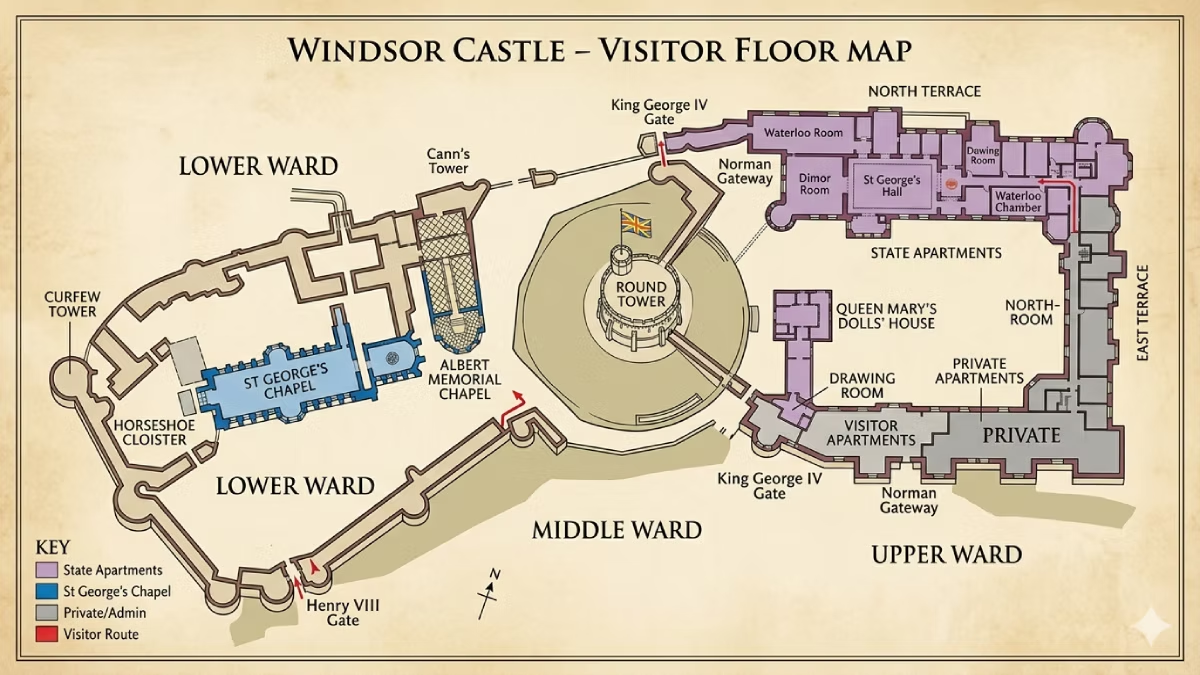
Windsor Castle is divided into three main areas: the Lower Ward (containing St. George’s Chapel and the Horseshoe Cloister), the Middle Ward (centred on the Round Tower), and the Upper Ward (containing the State Apartments, the Quadrangle, and the private royal apartments). Visitors enter from Castle Hill on the south side, pass through the Lower Ward, and move uphill through the Middle Ward to reach the State Apartments in the Upper Ward. The visitor route is one-way and exits from the north side of the castle.
Windsor Castle is large enough that first-time visitors often arrive unsure of how its various elements relate to each other. Where is St. George’s Chapel relative to the State Apartments? Where does the Round Tower fit? Which gate do you enter and exit through?
This guide explains the castle’s layout clearly — covering all three wards, the visitor route, and the most efficient sequence for seeing everything without backtracking.
The Three Wards: How Windsor Castle Is Organised
Windsor Castle is not a single building — it is a complex of buildings grouped around a central elevated mound, enclosed within defensive walls. The castle’s layout is traditionally described in terms of three “wards” (enclosed courtyards), arranged roughly west to east along the castle’s main axis.
The Lower Ward (West)
The Lower Ward is the western section of the castle and the first area you encounter after entering through the Henry VIII Gate from Castle Hill.
What’s here:
- St. George’s Chapel — the dominant building of the Lower Ward, running along the south side of the ward. One of England’s finest Gothic buildings and the burial place of 11 monarchs including Queen Elizabeth II and Henry VIII.
- The Horseshoe Cloister — a curving, half-timbered cloister immediately to the west of St. George’s Chapel, built in the 15th century for the chapel’s vicars choral. One of the most photographed spots in the castle grounds.
- The Military Knights’ Lodgings — a terrace of medieval and later houses on the south side of the Lower Ward, home to the Military Knights of Windsor, a small corps of retired army officers who participate in Garter ceremonies.
- The Curfew Tower — a circular tower in the northwest corner of the Lower Ward, dating to the 13th century, which originally housed the castle’s prison and bells.
Visitor tip: Enter St. George’s Chapel first, immediately on arrival. It closes at 16:00 on weekdays and is closed entirely on Sundays. If you leave it until after the State Apartments, you may find it closed.
The Middle Ward (Centre)
The Middle Ward is the smallest of the three wards and is dominated almost entirely by the Round Tower on its central mound.
What’s here:
- The Round Tower (Motte) — built on the original earth mound created by William the Conqueror, the Round Tower is Windsor Castle’s defining landmark. Henry II replaced the wooden keep with stone in the 1170s. George IV later raised its height by approximately 30 feet to improve the castle’s dramatic profile. The flagpole at the top of the Round Tower flies the Royal Standard when the King is in residence.
- The Norman Gate — the 14th-century gatehouse connecting the Middle Ward to the Upper Ward. Despite its name, it dates from the reign of Edward III, not the Norman period. The gate is a narrow, vaulted passage decorated with medieval carved lion masks.
Visitor tip: The Round Tower itself is not open to the public for interior access. Its value is as a visual landmark and as the point from which to read the flag — Royal Standard means the King is home; Union Flag means he is away.
The Upper Ward (East)
The Upper Ward is the largest of the three wards and contains the castle’s principal ceremonial and residential buildings. It is where most of the interior visit takes place.
What’s here:
- The Quadrangle — the large central courtyard of the Upper Ward, surrounded on all sides by the castle’s domestic buildings. This is the open space where the Changing of the Guard ceremony takes place on days when the King is in residence.
- The State Apartments — running along the north side of the Upper Ward, these are the main ceremonial rooms open to visitors. The visitor route through the State Apartments is one-way (see below).
- The Grand Entrance and King’s Staircase — the main ceremonial entrance to the State Apartments, added by George IV. The Staircase is lined with arms and armour.
- The private royal apartments — the south and east ranges of the Upper Ward contain the private residential apartments of the Royal Family. These are not open to visitors.
- The North Terrace — the stone terrace running along the north side of the Upper Ward, offering sweeping views across the Thames Valley and the Eton College playing fields. A popular spot for outdoor photographs.
- The Drawings Gallery — a long gallery containing rotating exhibitions of works on paper from the Royal Collection, including drawings by Leonardo da Vinci, Michelangelo, and Raphael.
Windsor Castle is divided into three wards: the Lower Ward (St. George’s Chapel, Horseshoe Cloister, Curfew Tower), the Middle Ward (the Round Tower on its mound), and the Upper Ward (the State Apartments, Quadrangle, private royal apartments, North Terrace). Visitors enter from Castle Hill in the south, move west to east through all three wards, and exit from the north side of the castle.
The Visitor Route: How It Flows
The Windsor Castle visitor route is one-way and follows a specific path through the castle. You cannot freely wander from area to area — the route is managed to control visitor flow and protect the historic spaces.
Standard entry sequence (from Castle Hill):
- Admission Centre — Castle Hill entrance. Security screening, ticket scanning, audio guide collection.
- Lower Ward — walk through the ward, passing the Military Knights’ Lodgings on the left and St. George’s Chapel on the right.
- St. George’s Chapel — enter the chapel from the Lower Ward. Visit the nave, the Garter stalls, and the chapels containing royal tombs.
- Middle Ward / Round Tower area — proceed from the Lower Ward past the Round Tower mound and through the Norman Gate.
- China Museum and cloakroom — near the entrance to the State Apartments. Pushchairs, large bags, and long umbrellas must be stored here.
- Queen Mary’s Dolls’ House — usually encountered just before or as part of the State Apartments entry. A separate room adjacent to the main visitor route.
- The State Apartments — the main interior visitor route. Proceeds one-way through a sequence of rooms: the Grand Entrance Hall, the King’s Staircase, the Grand Vestibule, the Waterloo Chamber, St. George’s Hall, the Grand Reception Room, the Garter Throne Room, the Presence Chamber, and the historic rooms associated with Charles II.
- The Undercroft Café — accessed after exiting the State Apartments, beneath St. George’s Hall.
- Exit — from the north side of the castle, past the castle shops, and out through the Henry VIII Gate or down to Windsor town.
Note: The one-way system means you cannot return to earlier parts of the route once you have passed through. If St. George’s Chapel is important to your visit, go there first — it is the only part of the route with a time-critical closing window (16:00 weekdays).
Key Distances and Timing
| Section | Walking Time | Notes |
|---|---|---|
| Castle Hill entrance to St. George's Chapel | ~5 minutes | Uphill approach to gate, then flat in Lower Ward |
| St. George's Chapel visit | 20–40 minutes | Longer if you want to locate specific tombs |
| Lower Ward to State Apartments entrance | ~10 minutes | Uphill through Middle Ward |
| State Apartments (full route) | 60–90 minutes | Depends on audio guide usage |
| Queen Mary's Dolls' House | 15–30 minutes | Most visitors stay longer than expected |
| North Terrace and outdoor precincts | 15–30 minutes | Optional; photography permitted |
| Total recommended visit | 2.5–3 hours |
What Is Not Accessible to Visitors
The visitor route covers a carefully managed portion of Windsor Castle. The following areas are not accessible to general visitors:
- The private royal apartments (south and east ranges of the Upper Ward)
- The Round Tower interior
- The castle kitchens and service areas
- The castle’s archives and library (except for specific research access)
- Most of the towers on the outer walls (Curfew Tower, Garter Tower, etc.)
- The Home Park and Frogmore (separate estate, occasional open days)
Frequently Asked Questions
How is Windsor Castle divided?
Into three wards: the Lower Ward (St. George’s Chapel and Horseshoe Cloister), the Middle Ward (Round Tower), and the Upper Ward (State Apartments, Quadrangle, private apartments). Visitors pass through all three on the standard visitor route.
Where is St. George’s Chapel in Windsor Castle?
St. George’s Chapel is in the Lower Ward — the westernmost section of the castle, the first area you reach after passing through the Henry VIII Gate from Castle Hill. Visit it first — it closes at 16:00 on weekdays and is closed on Sundays.
Where are the State Apartments?
The State Apartments are in the Upper Ward — the easternmost and largest section of the castle. They run along the north side of the Upper Ward’s central Quadrangle.
Can I move freely around Windsor Castle?
No. The visitor route is one-way and managed. You pass through a fixed sequence of spaces. You cannot return to earlier parts of the route once you have passed through.
Is the Round Tower open to the public?
The Round Tower interior is not open to general visitors. It serves as a landmark within the Middle Ward and as the flagpole position for the Royal Standard or Union Flag.
