

Windsor Castle's Round Tower: History, Views & Visitor Access
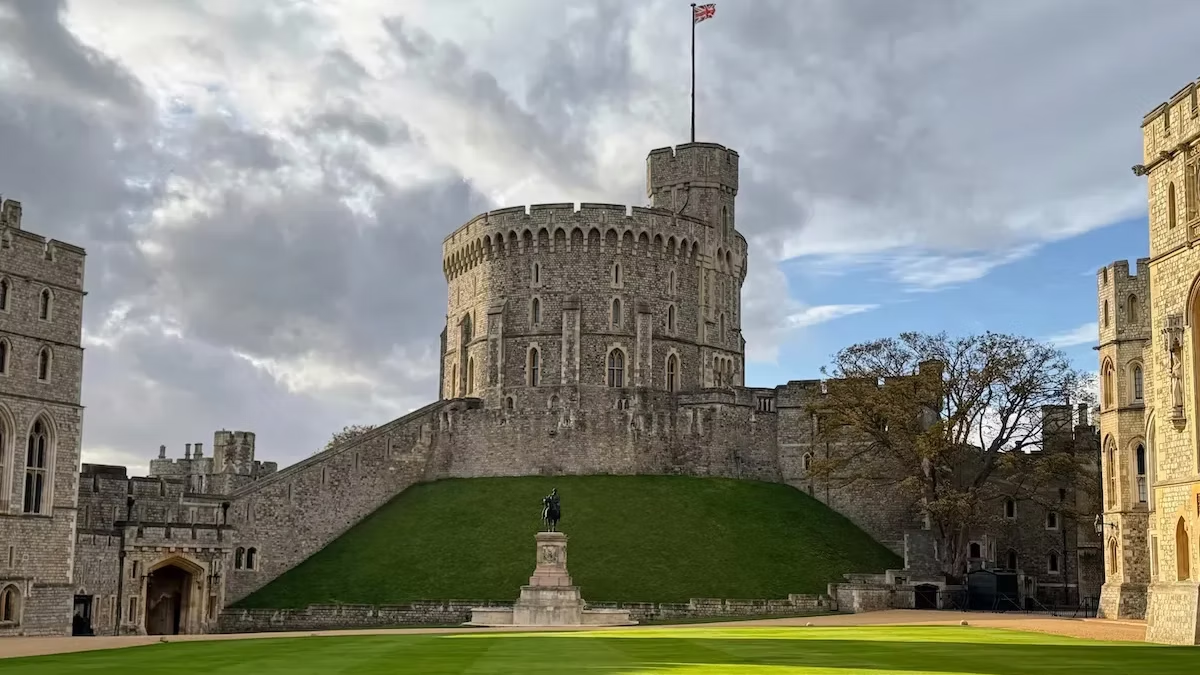
The Round Tower is Windsor Castle’s defining architectural feature — a massive circular keep on an artificial mound at the castle’s centre, visible for miles across Berkshire. The mound beneath it was created by William the Conqueror around 1070; the stone tower was built by Henry II in the 1170s; George IV raised it by 30 feet in the 1820s. The tower is not open to general visitors as standard, but the Conquer the Tower guided tour — bookable from approximately August to September — allows visitors to climb 200 steps to the top and view the Long Walk, Thames Valley, and London skyline from 65 metres up. The flag flying from the tower tells you whether the King is in residence.
The Round Tower is the most recognisable feature of Windsor Castle and one of the most recognisable towers in England. Its silhouette — a great drum of stone rising from an artificial hill, battlemented at the top, flying a flag that communicates whether the monarch is home — is reproduced on every depiction of Windsor and is visible from the surrounding countryside for many miles. It is the castle’s oldest surviving element and its visual anchor, the feature that makes Windsor look like the idea of a castle rather than merely a historic building.
History of the Round Tower
The Mound (c. 1070) The earthen mound on which the Round Tower stands is the oldest element of Windsor Castle — the original motte created by William the Conqueror around 1070. When William established his network of defensive castles, Windsor was built as a motte-and-bailey: an artificial hill (motte) with a wooden keep on top, surrounded by a stockaded courtyard. The chalk mound was constructed from material excavated from the surrounding ditch and still forms the base of the tower today, nearly 1,000 years later.
Henry II’s Stone Tower (1170s) Henry II replaced the wooden keep with the stone Round Tower during his comprehensive rebuilding of Windsor Castle in stone between 1165 and 1179. He also rebuilt the outer walls and the royal apartments in the Upper Ward during this period. The stone tower Henry built is substantially the lower portion of the tower visible today.
Edward III and the earliest clock (1354) Edward III had the earliest weight-driven mechanical clock in England installed in the Round Tower in 1354 — an early example of the castle’s recurring use of the tower for functions beyond pure defence.
George IV’s dramatic enlargement (1824–30) The most dramatic change to the Round Tower’s appearance was made by George IV, working with architect Sir Jeffry Wyatville. George wanted to transform Windsor Castle into a romantic Gothic palace, and the Round Tower’s profile was central to his vision. He had Wyatville raise the tower by approximately 30 feet — purely for visual effect, not for any structural or defensive purpose — creating a more dramatic, medievalising silhouette.
This addition is visible today: look carefully at the tower and you can see a slight change in the stonework approximately two-thirds of the way up, marking the join between Henry II’s original tower and George IV’s addition. The ring of stone at this point is where the battlements of the original tower once stood.
The Royal Archives and Library Since the 19th century, the Round Tower has served as the home of the Royal Archives — the historical records of the British monarchy, including state papers, personal correspondence of monarchs, and documents dating back centuries. The Royal Library’s most precious items are also stored here when not on display. Neither the archives nor the library are accessible to general visitors.
The Round Tower is Windsor Castle’s central keep, built on an artificial mound created by William the Conqueror around 1070. The stone tower was built by Henry II in the 1170s and raised by 30 feet by George IV in the 1820s. It houses the Royal Archives and flies the Royal Standard when the King is in residence. The interior is not on the standard visitor route; a guided Conquer the Tower tour (available August–September) allows visitors to climb 200 steps to the top for panoramic views.
Reading the Flag
The most immediately practical thing to know about the Round Tower is what its flag tells you about your visit.
Royal Standard flying (the sovereign’s personal flag — red, gold, and blue quarters with lions and a harp): The King is in official residence within Windsor Castle. This means the Changing of the Guard ceremony, if taking place that day, will occur in the Quadrangle of the Upper Ward rather than in the Lower Ward.
Union Flag flying: The King is not in residence. The Changing of the Guard, if taking place, will occur in the Lower Ward.
The flag is changed with ceremony: a dedicated flagman climbs to the top of the Round Tower and watches through binoculars for the King’s arrival or departure, hoisting or lowering the Royal Standard at the precise moment the King passes through the castle gates.
The Round Tower Is Not Actually Completely Round
Despite its name, the Round Tower has a square southern face — the tower is not a complete circle in plan. This quirk is one of Windsor Castle’s less-known architectural facts, apparent only on close examination of the southern side where the curved form flattens into a straight wall.
The Conquer the Tower Tour
The Conquer the Tower is a guided tour to the top of the Round Tower, operated by the Royal Collection Trust during a limited annual window.
Dates: Typically available during August and September. Check rct.uk for the confirmed dates each year.
What it involves: A guided tour lasting approximately 45 minutes, climbing 200 steps to reach the summit at 65.5 metres above the surrounding landscape.
The views: From the top, the panorama includes the full extent of Windsor Castle’s 13-acre grounds, the Long Walk stretching 2.65 miles south to the Copper Horse statue on Snow Hill, the River Thames winding east and west, the Eton College playing fields, and on clear days the London skyline. It is one of the finest elevated viewpoints in southern England.
The flagpole: The Conquer the Tower tour also brings visitors close to the castle’s 15-metre flagpole — the pole from which the Royal Standard or Union Flag flies.
Pricing (2026): The Conquer the Tower tour is a paid add-on to standard Windsor Castle admission.
- Full combined ticket (castle admission + tower tour) in advance: Adult £40, Young Person (18–24) £26, Child (over 1.3m) £20, Disabled visitor £20, Access companion free
- If you already have a standard castle admission ticket, 1-Year Pass, or Advantage Card, you can add the tower tour by calling +44 (0)303 123 7304 or at the castle’s Admission Centre on the day, subject to availability
Important restrictions: – Children must be over 1.3 metres (approximately 4ft 3in) tall to participate – Not suitable for those with acrophobia (fear of heights) or claustrophobia (fear of confined spaces) – Sensible, closed shoes must be worn (flip-flops and open sandals are not permitted) – Not recommended for visitors with health conditions that may be affected by sustained stair-climbing; consult your doctor before booking if in doubt – Not recommended for those in late pregnancy
What Visitors See Without the Tower Tour
The Round Tower’s exterior and the mound it stands on are fully accessible as part of the standard visitor route through the castle precincts. Walking through the Middle Ward — the area between the Lower Ward and the Upper Ward — brings you immediately alongside the tower’s base.
From the Middle Ward and the Quadrangle of the Upper Ward, the tower can be viewed and photographed from multiple angles. The best ground-level views are from the Quadrangle (looking west toward the tower) and from the Middle Ward approach before passing through the Norman Gate. The Moat Garden, set in the former dry moat around the tower’s mound, provides particularly intimate close-up views of the lower tower from below its wall line.
The tower interior — including the Royal Archives — is not accessible to general visitors on the standard route.
The Mound: Windsor’s Oldest Landmark
The earthen mound beneath the Round Tower deserves recognition in its own right. It is the oldest physical element of Windsor Castle — a human-made landform nearly 1,000 years old, constructed by people whose tools and methods were entirely different from anything available today. Walking around its base in the Middle Ward, looking up at the stone tower rising from it, provides perhaps the most direct physical connection to the castle’s Norman origins available to visitors anywhere in the grounds.
The mound has been strengthened and stabilised at various points — most recently during archaeological investigations in the 1980s and early 1990s that preceded the 1992 fire restoration. These investigations revealed pottery and artefacts from multiple periods of the castle’s occupation.
Frequently Asked Questions
Can you go inside the Round Tower?
Not on the standard visitor route. The Conquer the Tower guided tour, available in August and September, allows visitors to climb 200 steps to the top. Check rct.uk for dates and booking.
What does the flag on the Round Tower mean?
The Royal Standard (the sovereign’s personal flag) flying means the King is in residence at Windsor Castle. The Union Flag flying means the King is not present. The flag is changed with ceremony at the moment of the King’s arrival or departure.
Is the Round Tower really round?
Mostly, but not entirely. The southern face of the tower is straight rather than curved, giving the tower a slightly D-shaped plan rather than a perfect circle.
How high is the Round Tower?
The tower stands approximately 65.5 metres (215 feet) above the surrounding landscape from the base of the mound to the top of the battlements. George IV raised it by approximately 30 feet (9 metres) in the 1820s from its original height.
Who lives in the Round Tower?
No one lives in the Round Tower. It houses the Royal Archives and portions of the Royal Library. Access is restricted to authorised researchers and staff.
When was the Round Tower built?
The earthen mound dates to around 1070, created by William the Conqueror. Henry II built the stone tower in the 1170s. George IV raised it to its current height in the 1824–30 remodelling.
